3D printing for electricians and electronics engineers: enclosures, mounts, tools
3D printing for electricians and electronics engineers: how the technology makes daily work easier
Electricians and electronics engineers keep running into situations where they need a non-standard part: an enclosure for a home-made board, a mount for a sensor in an awkward spot, a blanking plate for a consumer unit that isn’t on sale. It used to mean improvising with whatever was to hand or waiting weeks for delivery. Today 3D printing makes the part you need in a few hours — exactly to your dimensions and requirements.
In this article we look at specific examples of the parts electricians and electronics engineers print most often and explain which materials suit each job.
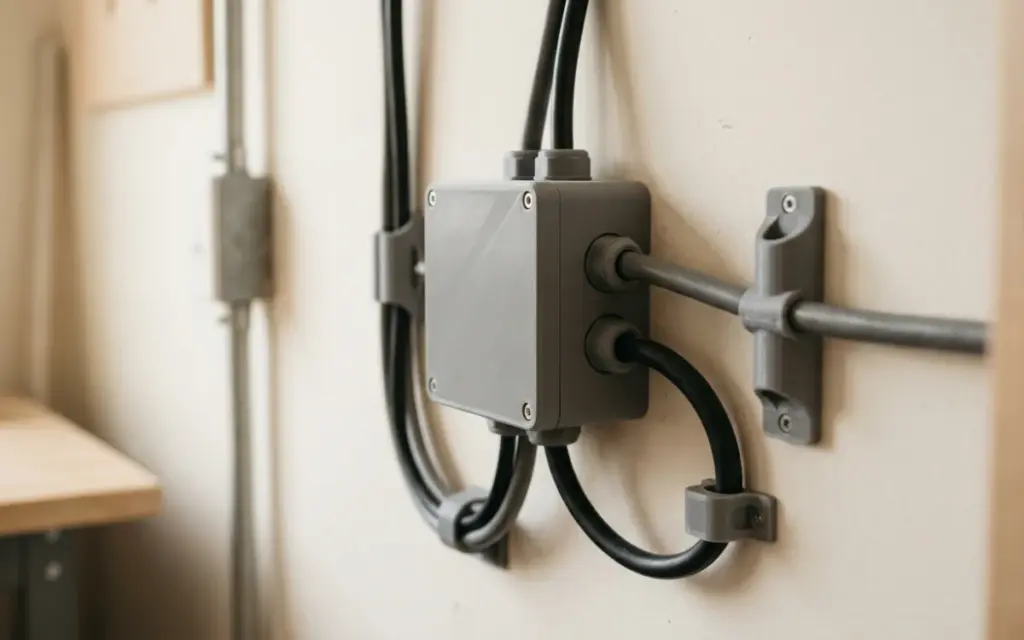
Enclosures for electronic devices and junction boxes
The most popular request among electronics engineers is making enclosures for home-made devices. These can be:
- Enclosures for junction boxes in non-standard sizes
- Boxes for smart home controllers and IoT devices
- Protective housings for power supplies and converters
- Enclosures for home-made devices based on Arduino and Raspberry Pi
The main advantage of 3D printing is that the enclosure can be designed exactly for your board, with openings for connectors, ventilation slots and mounts for specific screws. No off-the-shelf enclosure gives that precision of fit.
Custom panels with connector cut-outs
A separate category of jobs is making panels for equipment racks and instrument enclosures. A 3D printer can produce a front panel with precise cut-outs for any connectors: USB, RJ45, XLR, banana sockets, switches and indicators. This is especially useful for lab equipment, test rigs and home-made instruments, where standard panels simply don’t exist.
Blanking plates for consumer units
A familiar situation: there are empty spaces in the consumer unit after fitting the breakers, and the manufacturer’s blanking plates have run out or aren’t in stock. 3D printing solves this in a matter of hours. Blanking plates can be made for any type of unit, with precise clips and catches.
Cable organisers and markers
Tidy cabling is a sign of professionalism. 3D printing makes it possible to produce:
- Cable combs for grouping wires in consumer units
- Holders and clips for fixing cables to walls and in trays
- Marker tags with embossed or raised text that won’t rub off
- Grommets for routing cables through walls and partitions
Printed markers are more convenient than paper stickers — they don’t peel off or fade and can be read even in poor light.
DIN rail mounts
The DIN rail is the standard for mounting in consumer units. But far from every device comes with a factory adapter for it. With 3D printing you can create DIN rail mounts for:
- Single-board computers (Raspberry Pi, Orange Pi)
- Relays, voltage converters and charging modules
- Small power supplies and DC-DC converters
- Any non-standard modules that need to go in the unit
The adapter is designed for a specific device, with ventilation openings and access to the connectors. It’s much more reliable than fixing equipment with cable ties or double-sided tape.
Tools and fixtures for everyday work
Multimeter holders
During measurements there’s often nowhere to put the multimeter — it slides about, falls and gets in the way. A printed holder with a magnetic mount for the consumer unit or a hook for hanging solves this problem once and for all. You can also make an organiser for probes and extra leads.
Drilling templates
When you need to mark out holes for back boxes, mounts or cable entries accurately, a 3D-printed template becomes an indispensable helper. Design the template once and you can use it again and again, with perfect accuracy every time. PLA works well for templates — the part carries no mechanical load, so this material is strong enough.
Insulating covers and protective parts
Insulating covers and caps can be printed to protect exposed contacts, terminals and connections. They’re especially useful when working with low-voltage equipment, where protection from accidental contact or short circuits is needed. It’s important to remember that printed parts are not certified insulation for high-voltage circuits — they’re suitable for additional protection and organising space.
Which materials to choose for electrical parts
The choice of 3D printing material depends on the conditions the part will work in. Here are the main recommendations:
- PETG — the best choice for enclosures, mounts and parts that work near heat sources. It withstands temperatures up to 75–80°C and has good impact and chemical resistance. Ideal for enclosures in consumer units, DIN rail mounts and protective housings.
- PLA — suitable for templates, markers, temporary prototypes and parts that aren’t exposed to heat. PLA is easier to print and cheaper, but it softens at just 55–60°C, so it isn’t recommended for permanent installation next to power equipment.
- ABS and ASA — an option for parts used at elevated temperatures or outdoors. ASA is also UV-resistant.
For most electrical jobs we recommend PETG as the golden mean between ease of printing, strength and heat resistance.
How to order printed electrical parts
Ordering is simple and requires no special knowledge of 3D modelling:
- If you have a ready-made 3D model (STL, STEP), send it to us for a quote.
- If there’s no model, we’ll tell you where to find a ready-made one (on Printables, Thingiverse or MakerWorld) or who can make it.
- For standard parts (DIN rail mounts, blanking plates, holders) there are often ready-made models that just need adapting to your dimensions.
Printing one part usually takes from a few hours to a day, depending on its size and complexity.
Need a part for an electrical installation or electronics project?
Send us a 3D model — we’ll choose the best material and make the part as quickly as possible. No model? We’ll tell you where to find a ready-made one (on Printables, Thingiverse or MakerWorld) or who can make it. We work with PETG, PLA, ABS and other materials.
Have an idea for something to print? Send a model or a photo of the part — we’ll quote it within an hour and suggest the right material.