3D printing for drones: spare parts, mounts and upgrades
In short
- The parts most often printed for drones are propeller guards, camera mounts, landing gear and battery holders.
- TPU for anything that has to flex and absorb impacts; PETG for rigid mounts under vibration; PLA for prototypes and organisers.
- Thin 1.2–1.6 mm walls, 15–30% infill and a 0.2–0.3 mm hole tolerance are the basis of a light, accurate part.
3D printing for drones: how to print spare parts, mounts and upgrades
Sooner or later every drone pilot runs into the same problem: original spare parts are expensive, take ages to arrive or simply don’t exist for your particular task. 3D printing solves this quickly and efficiently. Instead of weeks waiting for a parcel from China, you get the part you need in a few hours — made exactly for your drone, from the right material and in the quantity you need.
In this article we look at which drone parts are most often printed on a 3D printer, which materials suit them and what to pay attention to when designing them.
Which drone parts can be printed
Propeller guards
This is probably the most popular 3D-printed part among drone pilots. Guards protect the propellers from hitting obstacles — walls, trees, furniture. They’re especially relevant for flying indoors or in tight spaces. They’re mostly printed in TPU — a flexible material that absorbs the energy of an impact without breaking or damaging the drone’s frame.
Camera mounts
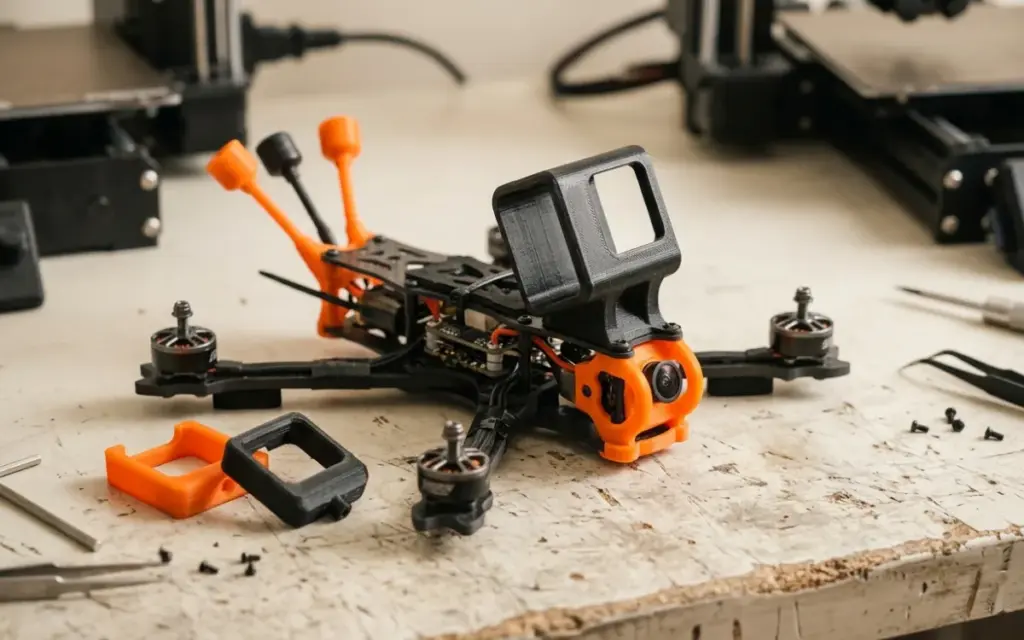
GoPro, DJI Action, Insta360 and other action cameras often need specific mounts to be fitted to a drone. Standard mounts don’t always suit the tilt angle, weight or fixing method. 3D printing lets you create a mount for a specific camera and a specific frame, accurate to a millimetre. PETG is usually used for these parts — it’s strong enough, withstands vibration and doesn’t deform with moderate heat.
Landing gear and legs
Landing legs increase the drone’s ground clearance and protect the camera and gimbal when landing on uneven ground. This is especially important for drones with gimbal cameras or extra equipment underneath. TPU legs spring on landing and cushion impacts, while PETG versions provide rigid, stable support.
GPS antenna mounts
A GPS antenna should be placed as high as possible and away from sources of interference. 3D-printed masts and mounts raise the antenna above the frame for better signal reception. These parts must be light and rigid, so PETG is the best choice here.
Custom top and bottom covers
Body covers protect the electronics from dust, moisture and mechanical damage. A custom cover can also include ventilation openings for cooling or mounting points for extra equipment. PLA will do for prototyping and testing, but for the final version PETG is the better choice — it’s more resistant to UV and temperature changes.
Battery holders
A non-standard battery or wanting to change its position for better balance is a typical situation. 3D-printed holders with Velcro or latch fixings solve this. The part must be strong but also slightly flexible so the battery is easy to fit, so a combination of PETG for the base and TPU for the retaining parts works best.
LED light mounts
LED strips and modules are used to keep track of a drone’s orientation at dusk, for night flights or simply for a visual effect. 3D printing lets you create neat mounts that hold the LEDs at the right angle without adding extra weight. Light mounts in PLA or PETG handle this job perfectly well.
Organisers for storing drones and accessories
Besides parts for the drone itself, a 3D printer also comes in handy for organising your workspace. Case inserts for specific propellers, holders for controllers, ventilated battery stands — all of these print easily in PLA and make storage and transport more convenient.
Which material to choose for drone parts
The choice of material is the key decision that determines whether a part will work as it should. Here’s a brief guide:
- TPU (thermoplastic polyurethane) — a flexible, impact-resistant material. Ideal for propeller guards, landing legs and anti-vibration pads. It absorbs the energy of an impact instead of breaking.
- PETG — strong, heat-resistant and chemically inert. Suitable for functional camera mounts, GPS masts and battery holders. It withstands vibration and doesn’t deform in the sun.
- PLA — the easiest material to print, with good detail. Suitable for prototypes, organisers and parts that aren’t exposed to serious loads or heat.
Read more about the properties of each material and how they compare in our article PLA vs PETG vs TPU. And the full list of available printing materials is on the materials page.
Tips for designing drone parts
3D printing for drones has its own specifics. Here are a few practical recommendations to help you get a good result:
- Minimise weight. Every extra gram affects flight time. Use thin walls (1.2–1.6 mm), reduced infill (15–30%) and lightening cut-outs wherever possible.
- Take vibration into account. A drone vibrates constantly. PLA parts can crack under cyclic loads, so choose PETG or TPU for critical assemblies.
- Print orientation matters. A part printed along the direction of the load withstands much more. Bear this in mind when placing the model on the bed.
- Add tolerances. For bolt and screw holes, add 0.2–0.3 mm to the nominal diameter so the parts assemble without trouble.
- Test in PLA first. If you’re designing a part yourself, make the first test print in cheap PLA, check the fit and dimensions, and only then print the final version in PETG or TPU.
Where to get 3D models of drone parts
If you don’t design yourself, ready-made models can be found on popular platforms: Thingiverse, Printables, Cults3D. Just enter your drone’s name and the type of part — chances are someone has already designed the model you need. Many FPV communities also share files openly.
If you need a unique part for your specific requirements and there’s no ready-made model, we’ll tell you where to find one (on Printables, Thingiverse or MakerWorld) or who can make it.
Ready to order printed parts for your drone?
Whether you need a simple propeller guard or a complex multi-part camera mount, we’ll print the part in the right material, in the correct orientation and with optimal settings. Send us a 3D model or describe the task — we’ll find the best solution.
Order 3D printing for your drone
Have an idea for something to print? Send a model or a photo of the part — we’ll quote it within an hour and suggest the right material.
FAQ
Which drone parts can be printed on a 3D printer?
Propeller guards, mounts for action cameras (GoPro, DJI Action, Insta360), landing gear and legs, GPS antenna masts, body covers, battery holders, LED light mounts and storage organisers.
Which plastic should I choose for drone parts?
TPU for guards, legs and anti-vibration pads, because it’s flexible and absorbs impacts. PETG for camera mounts, GPS masts and battery holders: it’s strong and withstands vibration. PLA for prototypes and organisers.
What wall thickness and infill should I use for drone parts?
To keep a part light, use 1.2–1.6 mm walls and 15–30% infill, and for screw holes add 0.2–0.3 mm to the nominal diameter.
Where can I get ready-made 3D models of drone parts?
On Thingiverse, Printables and Cults3D: enter your drone’s name and the type of part. FPV communities also share files.