3D printing for gamers: stands, keycaps and accessories
3D printing for gamers: how to make your gaming setup more comfortable and stylish
Every gamer knows that comfort at the gaming desk isn’t a luxury but a necessity. When headphones lie wherever, cables tangle under your feet and the controller slides across the desk, it’s irritating and makes it hard to focus on the game. 3D printing lets you create exactly the accessories your setup is missing — in precise sizes, with the design you want and at an affordable price.
In this article we look at the most popular gaming accessories that can be printed on a 3D printer: from custom keycaps to mounts for streaming gear.
Custom keycaps for mechanical keyboards
A mechanical keyboard is the heart of any gaming setup. But standard keycaps don’t always satisfy: you want to highlight the WASD keys, mark your macros or simply add some personality. 3D printing handles this perfectly.
- An exact fit — models are designed for a specific switch type (Cherry MX, Gateron, Kailh), so the keycap sits snugly and doesn’t wobble.
- Any shape — textured surfaces, game symbols, miniature figures on the keys — the only limit is your imagination.
- A choice of material — PLA suits standard keycaps, while for a soft press TPU is worth choosing. This flexible material is pleasant to the touch and reduces the sound of each keystroke.
If you want keycaps in translucent plastic for RGB backlighting, that’s possible too. Just choose clear or translucent PLA.
Stands for gamepads and controllers
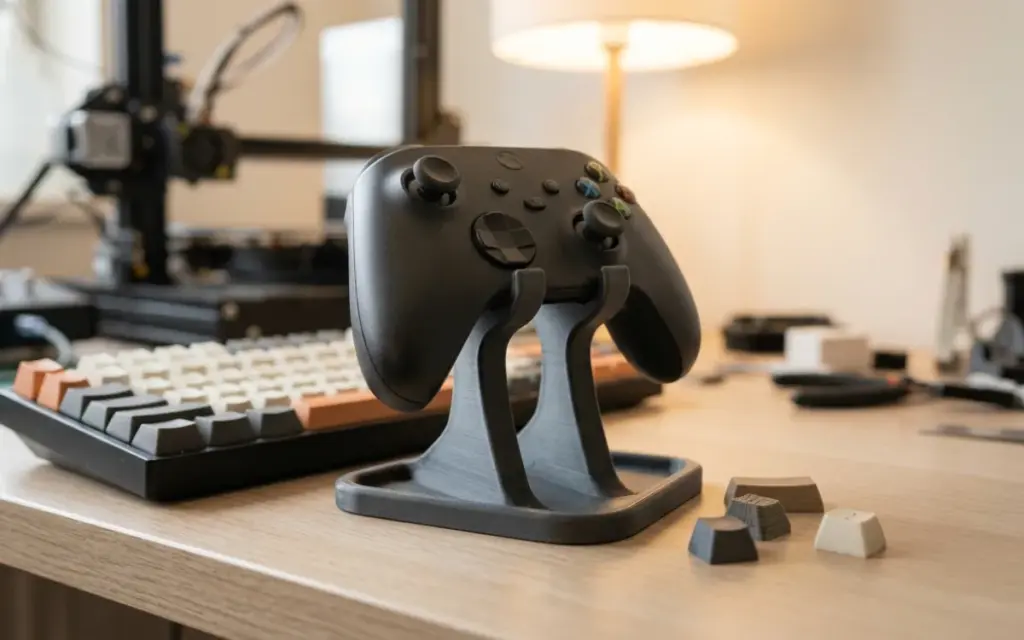
DualSense, the Xbox Controller, the Pro Controller for Nintendo Switch — each of them deserves its own place on the desk. 3D-printed stands hold the controller upright or flat, protect the sticks from accidental knocks and look neat.
A stand can be designed for a specific controller model, with a compartment for the charging cable or even an integrated smartphone holder for those who play on a mobile device. PLA is the best choice for these items: it’s strong enough, holds its shape well and comes in dozens of colours.
Headphone holders
Gaming headphones are often big and heavy. Just putting them on the desk is inconvenient: they take up space, slide around and the headband deforms over time. Printed holders come in several types:
- Desk stands — a stand with a wide base that the headphones hang on by the headband.
- Hanging holders — attach to the edge of the desk or to the monitor, freeing up the work surface.
- Wall holders — fixed to the wall with screws or double-sided tape.
Each type can include a groove for the cable so the wire doesn’t dangle about. It’s a small detail that makes the desk much tidier.
Stands for game consoles
A PlayStation, Xbox or Nintendo Switch needs a stable position with good ventilation. Manufacturers’ standard stands cost quite a lot, while a 3D-printed equivalent is several times cheaper.
The main thing when designing one is to take the console’s vents into account and not block them. A good stand lifts the body 10–15 mm above the surface, ensuring natural air circulation. If needed, you can add compartments for storing game discs or cartridges upright — and the console area becomes compact and tidy.
Organisers for game discs and cartridges
Collectors of physical game copies will appreciate printed organisers. For Nintendo Switch cartridges, these are compact boxes with a slot for each cartridge — handy for taking on the road. For PS5 or Xbox discs, upright racks for 10–20 cases that sit on a shelf or inside a cabinet.
These organisers are printed in PLA, are light and easy to modify: need more slots — just print an extra section.
Cable management for the gaming desk
Cables are the enemy of every gaming setup. Controller chargers, USB hubs, cables from the monitor, headphones and microphone — it all turns to chaos within days. 3D printing offers an elegant solution:
- Under-desk clips — hold cables along the underside of the desk, taking them completely out of sight.
- Cable channels — closed trays that attach to the back of the desk.
- Desk-edge clips — small clamps that stop the charging cable slipping onto the floor.
TPU works well for clips and retainers — its flexibility means it doesn’t break when bent and holds the cable firmly. Larger items such as channels are better printed in PLA. You can learn more about the properties of the materials on the 3D printing materials page.
Stands for VR headsets
VR headsets aren’t cheap, and they deserve proper storage. A printed stand for a Meta Quest, PlayStation VR2 or Valve Index holds the headset in a stable position, keeps dust off the lenses and looks much better than a headset left on the sofa.
A good option is a stand with a separate holder for the controllers, so the whole VR kit is kept in one place. It’s also handy when you want to get ready quickly and start playing.
Mounts for streaming gear
If you stream or record video, you’ll need mounts for a camera, microphone, ring light and other devices. Off-the-shelf solutions don’t always fit: a standard holder may be too big, have the wrong tilt angle or not attach to your desk.
3D printing lets you create a mount made exactly for your webcam or microphone model, with the rotation angle and type of fixing you need. For more complex designs with electronics — for example, mounts with an integrated USB hub — take a look at our experience in making enclosures for electronics.
Which material to choose
For most gaming accessories, PLA is optimal. It’s strong, has a smooth surface, comes in a wide range of colours and is easy to post-process — sanding and painting. Stands, organisers, holders, mounts — all of these print reliably in PLA.
TPU is the one to choose where flexibility or softness is needed: keycaps with a pleasant tactile feel, cable retainers, protective covers for controllers. The material is springy, wear-resistant and doesn’t crack when bent.
Ready to perfect your setup?
If you have an idea for a gaming accessory, we’ll help bring it to life. Send us a 3D model or simply describe what you need: we’ll choose the material, colour and best print settings. We take custom orders of any complexity.
Order 3D-printed gaming accessories — fill in the form on the website and we’ll get back to you within one working day.
Have an idea for something to print? Send a model or a photo of the part — we’ll quote it within an hour and suggest the right material.