Nylon for 3D printing — when you need maximum strength
What nylon is and why it’s considered one of the strongest 3D printing materials
When standard plastics aren’t enough and a part has to withstand serious loads, it’s time to look at nylon (polyamide) — an engineering polymer that has long proven itself in industry. In 3D printing the two most common types are PA6 and PA12. PA6 offers the highest strength and stiffness, while PA12 is easier to print, absorbs less moisture and is more stable to process. Both far outperform the familiar PLA and PETG mechanically.
Nylon is chosen when a part has to do more than look good — it has to actually work under friction, impact, vibration and chemical exposure. If you’re considering different printing materials, polyamide sits at the top of the strength pyramid among FDM plastics.
Key properties of nylon for 3D printing
Nylon combines properties no other common FDM material can match:
- High tensile and flexural strength — PA parts withstand loads at which PLA or ABS would simply crack.
- Wear resistance — nylon’s surface has a low coefficient of friction, which makes it ideal for moving parts, bushings and guides.
- Elastic without being brittle — unlike ABS, nylon bends without breaking and returns to its original shape.
- Chemical resistance — polyamide isn’t bothered by oils, petrol, most solvents or alkalis. This is critical for parts in contact with automotive fluids or industrial chemicals.
- Heat resistance — nylon’s operating temperature reaches +150–180°C depending on the grade, far higher than PLA (+60°C) or PETG (+80°C).
Nylon compared with PLA, PETG and ABS
To see where nylon fits among other materials, it helps to compare their properties. We’ve already done a detailed comparison of PLA, PETG and TPU, so here we’ll focus on nylon:
- PLA — the easiest to print, but brittle, with low heat resistance, and not suitable for functional parts under load. Nylon is 3–5 times stronger than PLA.
- PETG — a decent compromise between ease of printing and mechanical properties, but well behind nylon in wear resistance and impact toughness.
- ABS plastic — a classic engineering material, but nylon wins on flexibility, friction resistance and chemical inertness. ABS holds its shape better when printing, but nylon lasts much longer in use.
The conclusion is simple: if a part is decorative, PLA or PETG is quite enough. If a part works under load, nylon has no equal.
The challenges of printing with nylon: what to expect
Nylon is a material with character. It’s much harder to print than PLA or PETG, and these are the main challenges:
Moisture absorption — enemy number one
Nylon greedily absorbs moisture from the air. Even a few hours in the open can ruin a spool: during printing the moisture turns to steam, causing bubbles and stringing and badly weakening layer adhesion. Nylon must be dried at +70–80°C for 6–12 hours before printing, and ideally printed straight from a dryer.
High print temperatures
Nylon is extruded at +240–270°C, and the bed has to be heated to +80–110°C. Not every consumer printer can hold these temperatures reliably.
Warping and shrinkage
Nylon shrinks considerably as it cools, so parts often come unstuck from the bed or deform. To fight this, a heated enclosed chamber is critical — it keeps the temperature around the part even and minimises internal stresses. A special nylon adhesive or a PEI bed surface also helps.
Because of these challenges, it’s better to leave nylon printing to a service with the right equipment. On an ordinary open consumer printer the results are often unsatisfactory.
Nylon composites: even more strength
If even pure nylon isn’t enough, there are reinforced composites that take its properties to a new level:
- Carbon fibre nylon (PA-CF) — carbon fibre adds stiffness and reduces shrinkage. Its strength-to-weight ratio approaches that of aluminium. Ideal for tooling, drone frames and loaded brackets.
- Glass fibre nylon (PA-GF) — glass fibre increases stiffness and heat resistance, and the material is cheaper than its carbon counterpart. It’s well suited to covers, latches and parts that work at high temperatures.
Both composites are even more demanding on equipment: they quickly wear out ordinary brass nozzles, so they’re printed with hardened steel or ruby nozzles.
Where nylon 3D printing is used: real examples
Nylon isn’t a theoretical material. It works in real products every day:
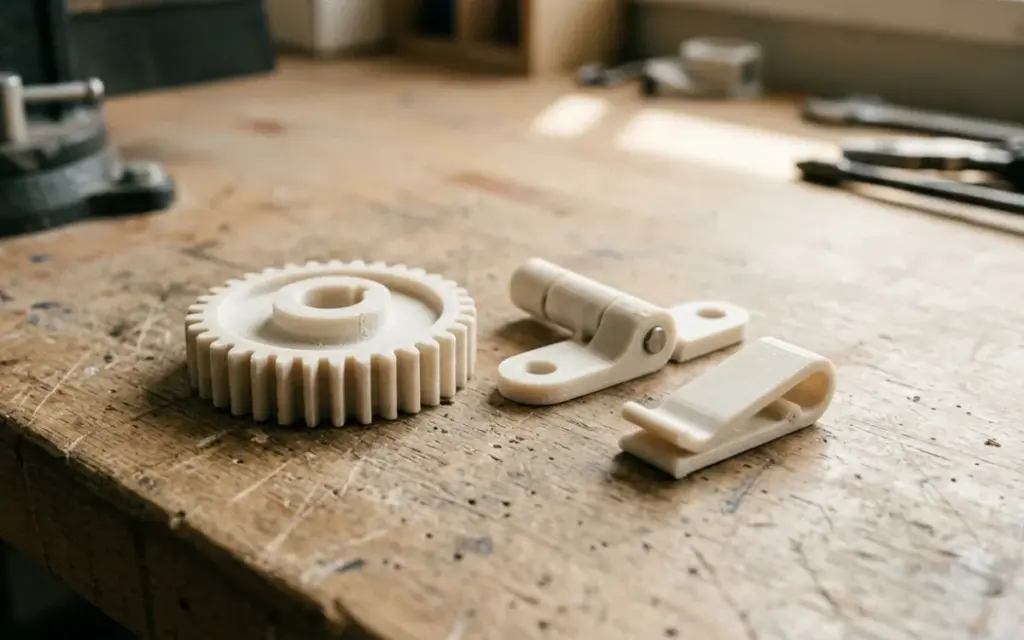
- Gears and gear wheels — nylon is the standard material for gears even in traditional manufacturing. In 3D printing it works just as well in mechanisms with moderate loads.
- Plain bearings and bushings — the low coefficient of friction lets nylon bushings run even without extra lubrication.
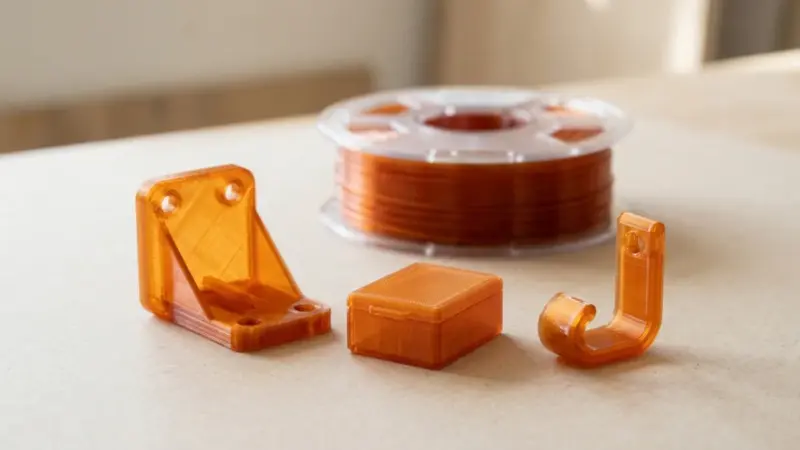
- Functional prototypes — when a prototype has to not just look like but work like a production part, nylon is the only sensible choice among FDM materials.
- Tools and fixtures (jigs & fixtures) — holders, jigs, clamps and templates for production lines. Nylon fixtures last for thousands of cycles.
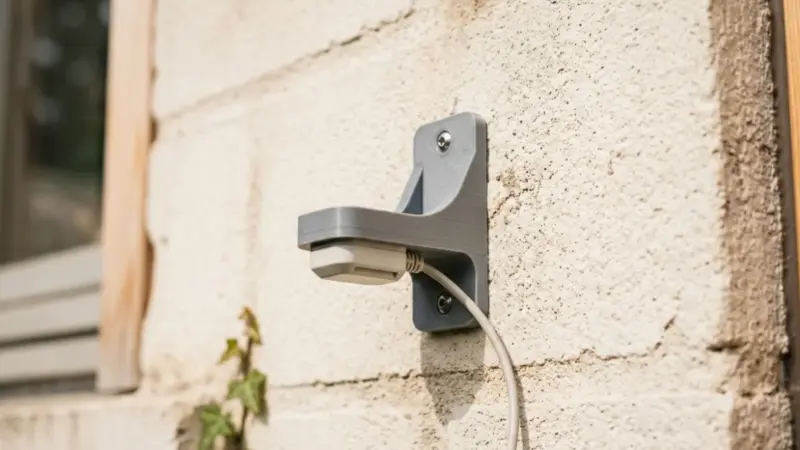
- Car parts — under-bonnet mounts, air ducts, covers and clips that work at high temperatures and come into contact with oils.
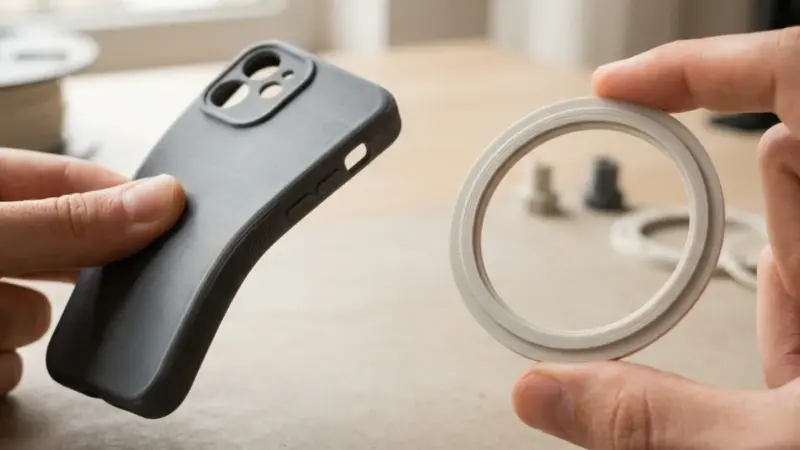
- Clips, catches and spring elements — thanks to its springiness, nylon is ideal for snaps and latches that have to flex repeatedly without breaking.
When to choose nylon and when another material?
Nylon isn’t a universal solution. It makes sense when at least one of these conditions applies:
- The part works under mechanical load (friction, impact, vibration).
- You need resistance to chemicals or oils.
- The operating temperature is above +80°C.
- The part has to flex without breaking.
- Durability and wear resistance are critical.
If the part carries no load, doesn’t touch aggressive substances and works at room temperature, PLA or PETG will be a cheaper and simpler solution. Choose the material for the job, not on the principle of “the more expensive, the better”.
How to store nylon properly
Even if you order printing from a service, it’s worth knowing that a spool of nylon filament needs airtight storage with silica gel. Once opened, it should be kept in a vacuum bag or a dedicated dry box. Drying before every print session is a must. That’s why professional services keep nylon in drying chambers and feed it straight from there into the printer. This guarantees consistent quality for every item.
Order nylon printing in Lviv
Printing with nylon requires specific equipment, experience and proper material preparation. Our service, 3dprint.lviv.ua, has everything needed: printers with enclosed chambers, hardened nozzles, drying equipment and years of experience with polyamides, including the reinforced PA-CF and PA-GF composites. We’ll help you choose the best nylon grade for your task, set the print parameters and ensure maximum strength of the finished part. Send us your model or a description of the part — we’ll work out the price and suggest the best solution.
Not sure which plastic to choose? Send the model and tell us where the part will be used — we’ll pick PLA or PETG and quote it within an hour.