3D printing gears and mechanical parts
Can you print a working gear on a 3D printer?
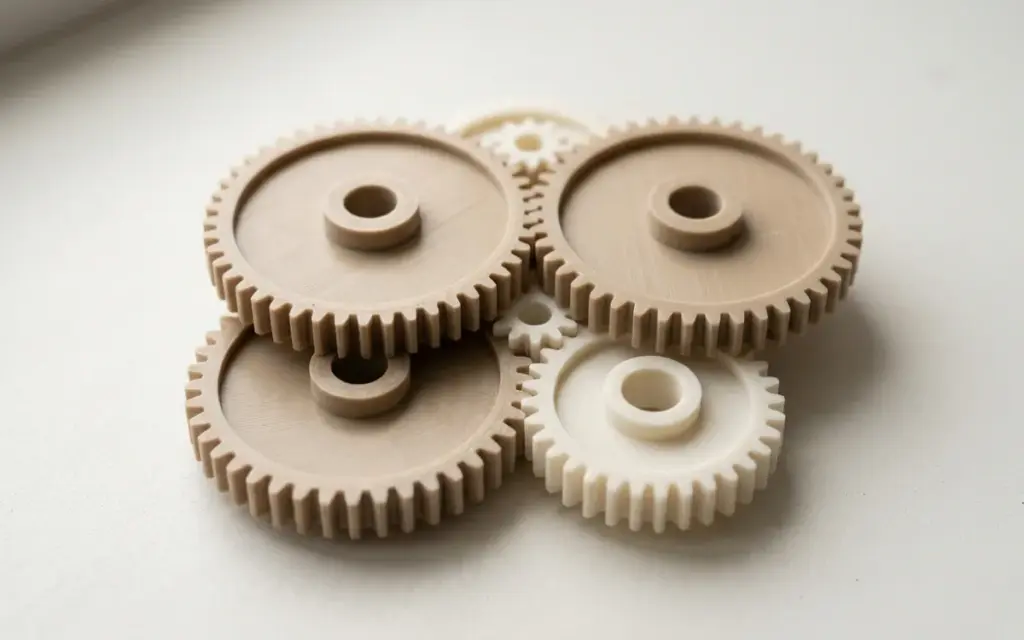
One of the most common questions from people getting into 3D printing: can you print a functional gear or mechanical part? The answer is yes, and it’s done far more often than you might think. 3D printing gears and mechanical parts has long gone beyond prototyping and is used to make fully working assemblies in household appliances, robotics, scale modelling and industrial equipment.
In this article we look in detail at how to design and print gears, bushings, hinges and other mechanical parts so they work reliably in real conditions.
Gear design basics for 3D printing
Module and tooth pitch
A gear’s module is the key parameter that defines tooth size. For FDM printing, we recommend a module of at least 1.0 mm, ideally 1.5–2.0 mm. A smaller module gives teeth that are too fine for an FDM printer to reproduce accurately enough.
- Module 0.5–0.8 mm — only for high-resolution SLA/SLS printing
- Module 1.0 mm — the minimum acceptable for FDM, needs careful tuning
- Module 1.5–2.0 mm — optimal for FDM printing, reliable and strong teeth
- Module 2.5+ mm — for large, heavily loaded gears
Minimum number of teeth
For proper meshing, a gear should have at least 8–10 teeth at the standard 20-degree pressure angle. With fewer teeth, the tooth root gets undercut, which weakens the gear. For 3D-printed gears we recommend at least 12–15 teeth for reliable operation.
Tooth profile
The most common tooth profile is involute. It gives smooth meshing and a constant gear ratio. Most CAD programs and online gear generators create exactly this profile. Gears with a trochoidal profile, which has smoother transitions between teeth, also work well for 3D printing.
Choosing a material for gears
PLA — for low loads
PLA suits gears with minimal load: decorative mechanisms, clocks, teaching models, mechanical toys. PLA is very stiff, which gives accurate transmission, but it’s brittle and can’t take shock loads. PLA also has limited wear resistance — its teeth wear down faster than those of other materials.
PETG — a balanced choice
PETG is a good compromise between strength, wear resistance and ease of printing. PETG gears handle moderate loads and have better impact toughness than PLA. It’s the best choice for most household uses: kitchen appliances, toys, window and door mechanisms.
Nylon — for maximum wear resistance
Nylon (PA) is the best material for functional gears. It has the highest wear resistance of the common 3D printing materials, excellent impact strength and a naturally slippery surface. Nylon gears are used in industrial equipment, automotive machinery and robotics.
- PA6 — general purpose, good wear resistance
- PA12 — absorbs less moisture, more stable dimensions
- PA-CF (carbon fibre filled) — maximum stiffness and wear resistance
TPU — for special applications
Flexible TPU is used for gears that need to absorb shocks or run silently. For example, in blind drives, where quiet operation matters, or in mechanisms at risk of jamming, where a flexible gear acts as a safety fuse.
You can learn more about the properties of each material on the 3D printing materials page.
Layer orientation — a critical factor
When printing gears and mechanical parts, layer orientation determines strength even more than the choice of material. It’s a key point that’s often underestimated.
Spur gears
Straight-cut spur gears should be printed flat, with the axis pointing up. In this position the layers are parallel to the plane of meshing, so the teeth are loaded in shear along the layers rather than pulling them apart. This gives maximum tooth strength.
Bevel gears
Bevel gears need an individual approach. They’re usually printed cone-up with supports, but for critical applications it’s better to consider printing in two parts and gluing them together.
Worm gears
The worm is printed lying down so the layers run along its axis. The worm wheel is printed upright, like an ordinary spur gear.
Tolerances for mechanical parts
The right tolerances are the key to any working mechanism. For FDM printing, use these recommendations:
- Centre distance between gears: add 0.1–0.2 mm to the calculated value
- Shaft hole: increase the diameter by 0.2–0.3 mm for free rotation, or by 0.1 mm for a press fit
- Tooth backlash: add 0.1–0.15 mm to the tooth space
- Keyway: increase the width by 0.15–0.2 mm
Always print a test pair of gears before the final part to check the meshing and smooth running. It will save time and material.
Bushings and plain bearings
3D-printed bushings are a simple, effective way to let a shaft rotate in a housing. Nylon is the best material for plain bushings thanks to its low friction coefficient and self-lubricating properties.
Tips for printing bushings:
- Minimum bushing wall thickness — 2 mm
- Clearance between shaft and bushing — 0.15–0.25 mm
- Print with 100% infill for maximum strength
- Orientation — upright, axis pointing up
- After printing, finish the bore with a reamer or sandpaper
To build standard ball bearings into 3D-printed parts, design a seat with a 0.05–0.1 mm diameter tolerance for a snug fit.
Hinges
Assembled hinges
A classic two-part hinge with a pin is the most reliable option. The pin can be metal (a nail or bolt) or printed. Leave 0.3–0.5 mm of clearance between the pin and the hole for free movement.
Print-in-place hinges
One of the most interesting things about 3D printing is making hinges that come off the printer already assembled. For a successful print you need 0.3–0.5 mm of clearance between the moving parts and careful retraction tuning to stop them fusing together.
TPU living hinges
Living hinges are thin flexible bridges that join rigid parts of a component and let them bend relative to each other. TPU can make a living hinge that survives thousands of flex cycles. The optimal bridge thickness is 0.4–0.8 mm, and the bend radius should be as large as possible.
Living hinges are used in:
- Flip-top enclosure lids
- Protective cases
- Boxes and containers
- Flexible joints between sections
Snap-fit joints
Snap-fit joints let you assemble parts without screws or glue. For 3D printing, cantilever snaps work best — springy tabs that lock into slots.
Key parameters for designing snaps:
- Length of the spring element: the longer it is, the lower the stress when it bends
- Engagement angle: 30–45 degrees for an easy joint, 70–90 degrees for a permanent one
- Thickness: 1–2 mm depending on the material and the stiffness needed
- Print direction: the spring element should bend along the layers, not across them
PETG and TPU are the best materials for snaps, since PLA is too brittle and a snap can simply break instead of springing.
Examples of mechanical applications
Household appliances
Replacing broken gears in food processors, meat grinders and bread makers is one of the most popular uses. Nylon gears can work just as well as the original plastic parts.
Robotics
Servo gearboxes, differentials for robot platforms, gripper mechanisms — all of these are printed and work successfully. PLA is enough for educational robots; competition robots need PETG or nylon.
Scale modelling
Mechanisms for RC models, working engine models, clock movements — 3D printing opens up endless possibilities for modellers.
Industrial equipment
Temporary replacements for worn gears and bushings keep equipment running until the original spare parts arrive. On the spare parts printing page at 3dprint.lviv.ua you can order mechanical parts for any need.
Tips for printing mechanical parts successfully
- Use a layer height of 0.12–0.16 mm for gears — it improves the surface quality of the teeth
- Set 80–100 percent infill for loaded parts
- Increase the number of perimeters to 4–5 for stronger walls
- Reduce print speed to 30–40 mm per second for better accuracy
- Use part cooling for PLA and PETG for crisper details
- Lubricate finished gears with silicone or lithium grease to reduce friction and wear
Check our 3D printing prices for mechanical parts at 3dprint.lviv.ua.
Order gears and mechanical parts
Printing good gears and mechanical parts takes experience and a well-tuned printer. If you need a reliable mechanical part, contact 3dprint.lviv.ua. We have experience printing functional gears, bushings, hinges and other mechanical components in different materials. Get in touch for advice — we’ll help you choose the best material and print settings for your task.
Order 3D printing
Need quality 3D printing? spare parts printing. PETG materials. calculate the price. Delivery across Ukraine by Nova Poshta.
Have an idea for something to print? Send a model or a photo of the part — we’ll quote it within an hour and suggest the right material.