TPU for 3D printing: a flexible material for elastic parts
What TPU is and why it’s special
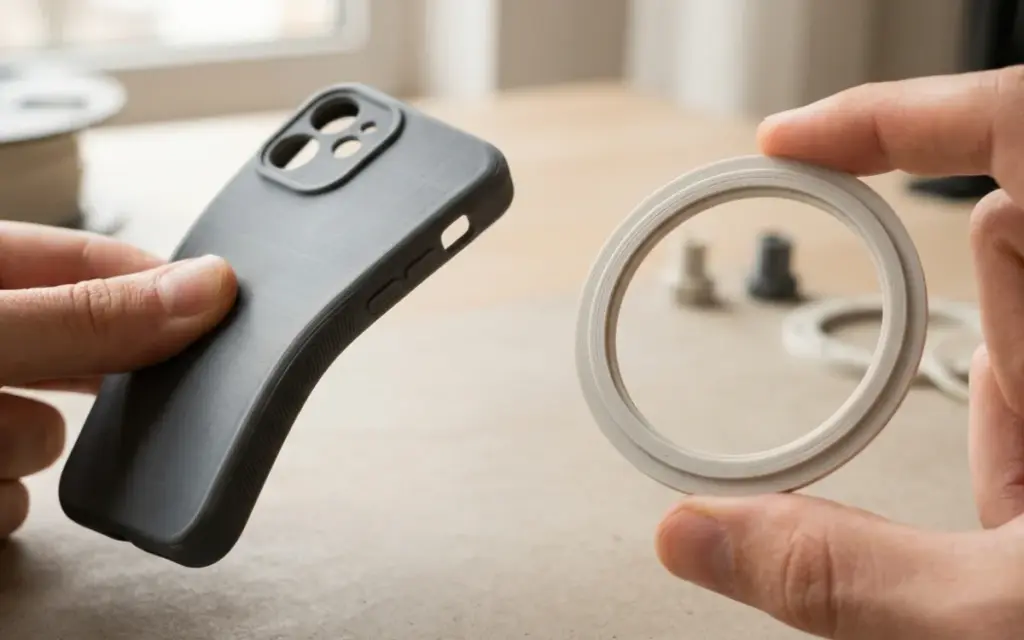
TPU (thermoplastic polyurethane) is a flexible, elastic 3D printing material that combines the properties of plastic and rubber. Unlike rigid PLA or PETG, a part printed in TPU bends, stretches, absorbs impacts and returns to its original shape. That’s why TPU for 3D printing is chosen when elasticity, cushioning or resistance to mechanical stress is needed.
Chemically, TPU belongs to the polyurethane family. Its molecular structure contains both hard and soft segments, which gives it a unique balance of flexibility and strength. In 3D printing this material occupies a niche of its own — it’s indispensable where a rigid plastic would simply crack.
Shore hardness: what the numbers mean
The key property of any flexible material is its hardness on the Shore scale. Most TPU filaments for desktop 3D printers have a hardness of 95A — the standard that gives the best balance between flexibility and ease of printing. For comparison:
- 60A–70A — soft, like a car tyre (very hard to print).
- 85A — soft TPU, like a dense rubber mat.
- 95A — standard TPU, like a trainer sole. This is the grade most services print.
- 98A–100A — semi-rigid, bends with noticeable effort.
The lower the number, the softer the material — and the harder it is to print. For the vast majority of jobs, TPU 95A is the ideal choice: flexible enough for gaskets and cases, yet it feeds into the printer reliably.
Key properties of TPU
TPU stands out with a whole set of properties that no rigid plastic can replace:
- Elasticity and flexibility — a part can be bent, twisted and stretched without breaking.
- Impact absorption — TPU cushions impacts, protecting whatever is inside (ideal for protective cases).
- Vibration damping — an indispensable property for automotive and technical applications where vibration needs isolating.
- Chemical resistance — TPU resists oils, fats, many solvents and fuel.
- Abrasion resistance — a TPU surface wears much more slowly than PLA or even PETG.
- Cold resistance — it stays elastic down to -40°C and doesn’t become brittle.
Printing TPU: what you need to know
Printing with flexible filament is quite different from working with ordinary materials. TPU demands patience and the right settings, otherwise you’ll get a tangle of strings instead of a part. Here are the main nuances:
Print speed
TPU is printed slowly — a typical speed is 20–30 mm/s, while PLA prints comfortably at 60–80 mm/s. Trying to go faster makes the soft filament buckle in the extruder instead of being pushed through the nozzle.
Extruder type
The best results come from a Direct Drive extruder, where the motor sits right above the nozzle. In Bowden systems (with a long tube between the motor and the nozzle), soft TPU often jams or compresses in the tube. Printing on a Bowden is possible, but only with the hardest grades (98A+) and at minimum speed.
Stringing
The main cosmetic problem when printing TPU is stringing (thin threads between features). The flexible material doesn’t respond well to retraction, so it’s hard to get rid of strings completely. Lowering the nozzle temperature by 5–10°C and using a minimal retraction distance (0.5–1 mm for Direct Drive) helps.
Adhesion and temperature
TPU is printed at a nozzle temperature of 220–240°C, with the bed at 50–60°C. Bed adhesion is usually excellent, but removing the finished part can be tricky — the flexible base clings to the surface. A light coat of release agent on the bed or a removable build plate helps.
Where TPU is used: the best use cases
TPU’s unique properties make it the ideal material for a whole class of items that can’t be printed in rigid plastic:
- Protective cases for phones and gadgets — a custom case that fits a specific device perfectly and protects it reliably from drops.
- Gaskets and seals — replacements for worn rubber gaskets for household appliance repair, plumbing and cars.
- Anti-vibration dampers — mounts for motors, fans and pumps that dampen vibration and reduce noise.
- Shoe insoles — orthopaedic or sports insoles printed from an individual foot impression.
- Protective bumpers for drones — light, elastic bumpers that absorb impacts in a collision and protect the quadcopter frame.
- Flexible joints and hinges — living hinges for lids, boxes and complex mechanisms that withstand thousands of bending cycles.
- Protective pads — for furniture corners, tools and work surfaces — wherever soft contact is needed.
- Wheels and rollers — for robots, models and internal transport — silent and with good grip.
TPU vs soft PLA and silicone
There are alternatives to TPU on the market, but each has significant limitations. Let’s look at the key differences:
Soft PLA
Some manufacturers offer flexible PLA, but its elasticity is much lower — it’s more “a plastic that bends a bit” than a true elastomer. Soft PLA is less abrasion-resistant, can become brittle over time and doesn’t provide real cushioning. Its only advantage is easier printing, as it’s less prone to stringing. It will do for decorative parts, but not for functional ones.
Silicone
Real silicone can’t be printed on ordinary FDM printers — it needs specialised equipment. Silicone parts are made by moulding, which is much more expensive for one-off items. TPU at 85A–95A hardness gives properties close to silicone but prints on a standard 3D printer, which makes it an affordable alternative for prototyping and small batches.
Read more about the differences between materials in our comparison of PLA, PETG and TPU.
How to store TPU filament properly
TPU is hygroscopic — it actively absorbs moisture from the air. Damp filament hisses during printing, forms bubbles, gives a rough surface and weak bonds between layers. To avoid this, follow a few simple rules:
- Store it in airtight packaging with silica gel sachets. Vacuum bags with a valve are ideal.
- Don’t leave the spool on the printer after printing. Even a few days in the open during a humid season can ruin the filament.
- Dry it before printing if the spool has been left open for a long time. The best drying temperature is 50–55°C for 4–6 hours in a dedicated dryer or an ordinary fan oven.
- Use a dry box — a closed box with a filament feed that lets you print straight from an airtight container.
Read also
Order TPU printing in Lviv
If you need a flexible, elastic part — a case, a gasket, a damper or any other TPU item — we’ll help bring your idea to life. Send a 3D model or a description of the part via the contact form, and we’ll work out the price, choose the best material hardness and print your part to the highest quality. We print from a ready-made 3D model (STL, OBJ, STEP or 3MF); if there’s no model, we’ll tell you where to find a ready-made one (on Printables, Thingiverse or MakerWorld) or who can make it.
Not sure which plastic to choose? Send the model and tell us where the part will be used — we’ll pick PLA or PETG and quote it within an hour.