3D printing for jewellery making — from wax models to finished pieces
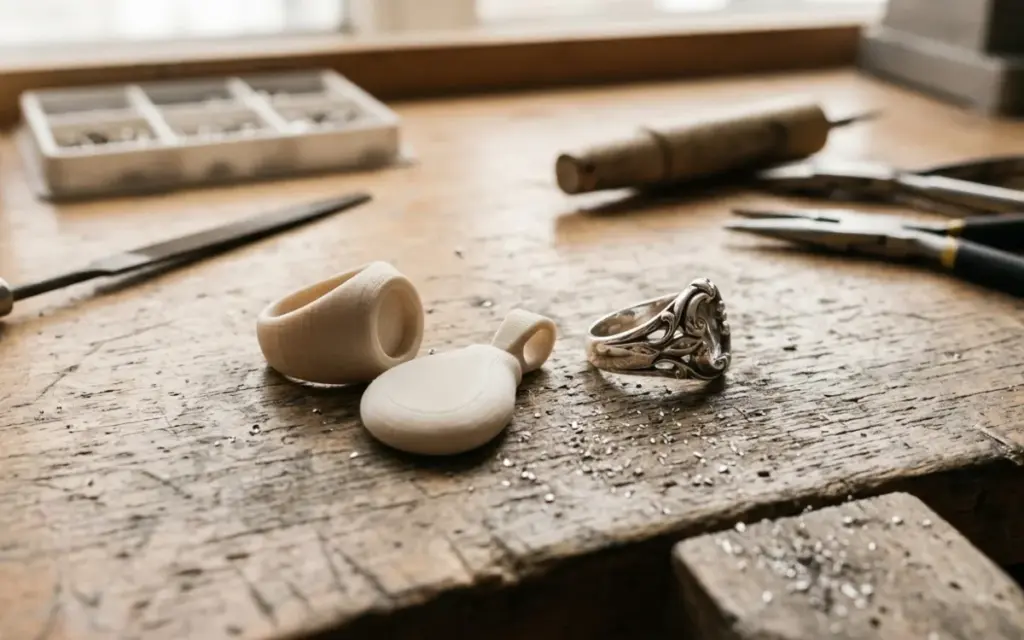
3D printing for jewellery making — how technology has changed the way jewellery is made
Jewellery making is one of humanity’s oldest crafts. For centuries, craftsmen made every ring, pendant and earring by hand. But the arrival of 3D printing has brought a real revolution to the industry. Today additive manufacturing makes it possible to create jewellery of any complexity — from exclusive wedding rings to production collections — faster, more precisely and more affordably than ever before.
In this article we look at exactly how 3D printing is used in jewellery making, which technologies and materials suit it best, and why it has become indispensable both for professional jewellers and for anyone who wants to order a unique piece.
Lost-wax casting: a classic technique with a new approach
Lost-wax casting has been used in jewellery making for thousands of years. The principle is simple: first a wax model of the future piece is made, a plaster mould is formed around it, the wax is melted out, and molten metal — gold, silver or platinum — is poured into the cavity.
Wax models used to be carved by hand, which took enormous skill and time. Now they can be printed on a 3D printer from jewellery wax or a special resin that burns out without residue. This gives several key advantages:
- Perfect precision — detail down to 25–50 microns, beyond what handwork can achieve
- Repeatability — you can print dozens of identical models for production
- Complex geometry — openwork patterns, internal cavities and interlacing that can’t be carved by hand
- Speed — from digital model to wax blank in a few hours instead of several days
SLA and DLP printing — the gold standard for jewellers
The technologies best suited to jewellery making are SLA (stereolithography) and DLP (digital light processing). Both work with photopolymer resins that harden under ultraviolet light. Their key advantage is exceptional detail and a smooth surface on the finished models.
Why SLA/DLP for jewellery?
SLA/DLP printers reach a resolution of 25 microns on the Z axis, which reproduces the finest details: thin filigree elements, microscopic lettering and complex textures. After printing, the model needs minimal post-processing, and the surface comes out almost perfectly smooth.
There are specialised materials for jewellery printing — so-called castable resins. They’re designed to burn out completely at 700–800°C, leaving no ash or residue in the casting mould. This is critical for getting a clean surface on the metal piece.
FDM printing in jewellery making: prototyping and design checks
Although FDM technology doesn’t give enough detail for final jewellery models, it has its place in the workflow. An FDM printer is ideal for:
- Rapid prototyping — print a ring in PLA in 20 minutes to check the size and proportions
- Checking the fit — the client can try on a plastic copy before an expensive gold piece is made
- Design presentations — showing a client a physical model is far more effective than an image on a screen
- Learning — beginners can practise design without spending money on expensive materials
An FDM prototype costs just a few hryvnias, so you can print dozens of iterations until the design is perfect.
Software for 3D modelling jewellery
To print a piece of jewellery, you first need a digital 3D model. These are the programs jewellers use most often:
Professional solutions
- RhinoGold (MatrixGold) — the industry standard for jewellery modelling. It has a library of standard stone settings and tools for creating rings, pendants and earrings. It works as a plug-in for Rhinoceros 3D.
- ZBrush — suits organic, sculptural forms. Ideal for designer jewellery with complex shapes.
- Rhinoceros 3D — a powerful NURBS program for precise parametric modelling.
Free alternatives
- Blender — free software with huge capabilities. It takes time to learn but lets you create professional-level models.
- Meshmixer — a handy tool for editing and preparing models for printing, adding supports and analysing wall thickness.
Read more about free 3D modelling software in our separate article.
Personalised jewellery: wedding rings, pendants, lockets
One of the most popular directions is creating personalised jewellery to order. 3D printing has made this accessible to everyone. Here are just a few examples:
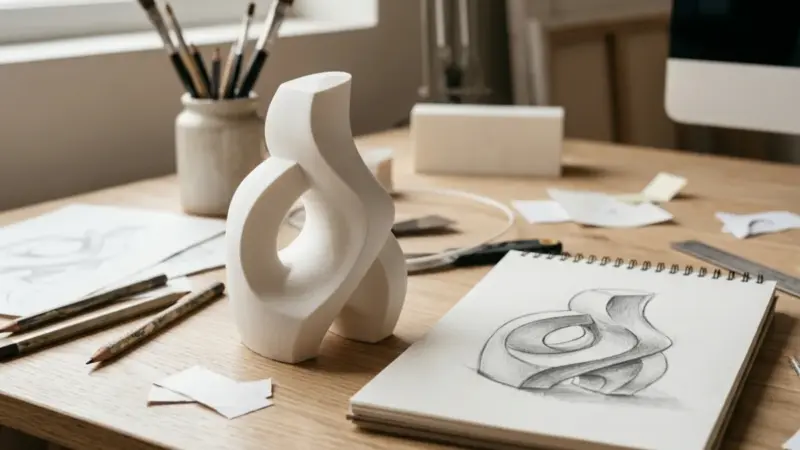
- Exclusive wedding rings — a unique design no one else will have. The client takes part in the process from sketch to finished piece.
- Pendants with names and dates — calligraphic text printed to within tenths of a millimetre.
- Copies of antique jewellery — 3D scanning and printing make it possible to recreate a vintage piece or create a modern interpretation of it.
- Figurative cufflinks, brooches, tiaras — any shape, limited only by the designer’s imagination.
Small-batch production: the advantages of 3D printing
For small jewellery brands and workshops, 3D printing has opened up possibilities that used to be available only to large manufacturers. Instead of making expensive rubber moulds, wax models can be printed straight from a digital file.
This means a run of 10–50 identical pieces becomes economically viable. No tooling costs, no minimum batches. Need 15 identical pendants as wedding favours? A 3D printer will print them overnight.
Cost comparison: 3D printing vs traditional handwork
The economic advantage of 3D printing is especially noticeable for complex pieces. Here’s a rough comparison for a ring of medium complexity:
- Hand-carving a wax model — 4–8 hours of a craftsman’s work, from 1,500–3,000 UAH for the model alone
- 3D modelling + printing — 1–3 hours of modelling + 2–4 hours of printing, from 500–1,500 UAH
- Reprinting the same model — material costs only, from 50–150 UAH
And the digital model is kept forever. If a year later the client wants the same ring in a different size, you just change one parameter and print it again. With the traditional approach, you’d have to start from scratch.
Ready to order 3D printing for a jewellery project?
Whether you’re a professional jeweller looking for a reliable partner to print wax models, or you want to order a unique piece for yourself or someone close to you, we’re ready to help. Our SLA printers deliver the detail jewellery making needs, and our experience with castable resins guarantees a quality casting result. Get in touch to discuss your project, get advice or order a jewellery model print.
Have an idea for something to print? Send a model or a photo of the part — we’ll quote it within an hour and suggest the right material.