3D printing for kids — safe toys and educational models
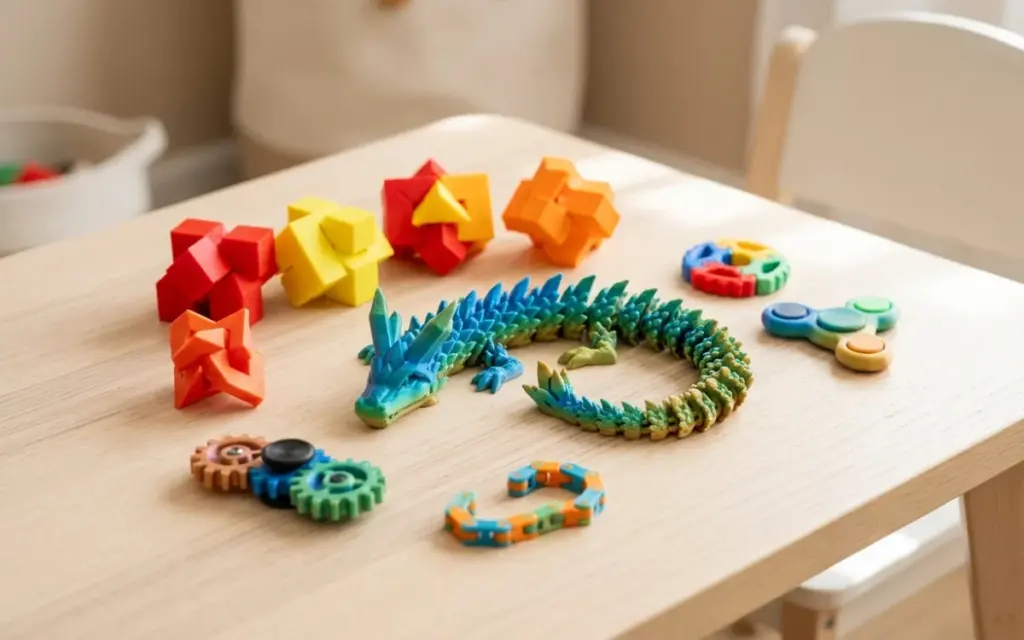
3D printing for kids: safe custom toys and educational models
Today’s parents increasingly look for alternatives to mass-produced plastic toys of questionable quality. 3D printing opens up new possibilities — from personalised toys to educational models that help a child discover the world. In this article we explain why 3D-printed toys are safe, which models are worth ordering for children of different ages and how it works in practice.
Are toys printed on a 3D printer safe?
This is the first question parents ask — and rightly so. Let’s look at the main safety aspects.
PLA plastic: eco-friendly and non-toxic
We print most children’s toys in PLA, a material made from corn starch or sugar cane. PLA is considered a food-safe material, meaning it’s safe in contact with food, let alone during ordinary play. Unlike cheap toys of unknown origin, you know exactly what the item is made of. Read more about this material’s properties in our article on how eco-friendly PLA is.
No sharp edges
When preparing for printing and during post-processing, we make sure parts have no sharp edges or burrs. Every toy can be sanded further to make it completely smooth and pleasant to the touch.
Part size for small children
For children under 3, it’s critical that no part is smaller than 4 cm — this prevents the risk of swallowing. When ordering, always tell us the child’s age, and we’ll take it into account when preparing the model. More about the available printing materials and their properties is on a separate page.
Educational toys: learning through play
3D printing is ideal for creating educational models that combine fun with learning. Here are the most popular categories.
Puzzles and brain teasers
3D puzzles develop spatial thinking, fine motor skills and logic. They can be classic puzzle cubes, animal puzzles or miniature architectural models the child assembles on their own. The difficulty is easy to adapt to age — from simple shapes with 4–5 pieces to real engineering challenges for teenagers.
Geometric shapes and maths models
A set of three-dimensional geometric solids — a cube, sphere, pyramid, cone and cylinder — helps children understand maths through touch. When a child holds an octahedron or a dodecahedron, abstract concepts become concrete. Such sets are useful both at home and at school.
Letters and numbers
3D letters of the Ukrainian alphabet are a great tool for getting ready for school. A child can:
- learn letters by touch, which engages tactile memory;
- make words on a table or a magnetic board (with built-in magnets);
- paint the letters to reinforce learning;
- play word games with parents or friends.
Animal and dinosaur models
Realistically detailed figures of dinosaurs, animals or insects are both a toy and a learning aid. A child remembers the names of species, learns about body structure and imagines ancient eras. If you’re looking for ready-made files to print, check out our collection of resources on where to find free 3D models.
Personalised toys: a special gift for a child
One of the main advantages of 3D printing is the ability to make something unique. Personalised toys become favourites precisely because they’re one of a kind.
- A toy with the child’s name — blocks, keyrings, door signs or a name pencil holder.
- Favourite characters — figures of heroes from cartoons, fairy tales or video games that you won’t find in an ordinary shop.
- A miniature of a pet — a modeller can create a figure of a cat, dog or hamster from a photo, and we’ll print it.
- Themed sets — for example, a farm with animals, a town with little houses or a space station.
Toys like these make wonderful gifts for a birthday, St Nicholas Day or just because.
Accessories for board games
If your family loves board games, 3D printing will add new excitement. We can make:
- Unique player figures — instead of standard counters, each family member gets a personal miniature.
- Custom dice — with a non-standard number of faces or an original design.
- Component organisers — stands, trays and sorters so game pieces don’t get lost.
- Card and token holders — handy holders that make playing easier for small hands.
By the way, game organisers are just one example of useful things. Also check out our article on 15 things for the home worth printing on a 3D printer.
STEM learning: simple mechanisms and engineering models
3D printing is a powerful tool for STEM education (science, technology, engineering and maths). Children can learn physics and mechanics from real models rather than a textbook.
Gears and transmissions
A set of gears the child connects together clearly shows how mechanical transmission works. How does one gear turn another? Why does the speed change? The answers become obvious when you hold the mechanism in your hands.
Levers and simple machines
Models of a lever, a pulley, an inclined plane and a screw help children understand the basic principles of physics. This is especially useful for pupils in years 5–8 who study mechanics at school.
Take-apart models
An anatomical model of the heart, an internal combustion engine or a model of the Solar System — all of these can be printed as parts that come apart and go back together. This approach turns complex topics into a fascinating activity.
Ideas for different ages
To make choosing easier, we’ve put together a rough list by age group:
- 1–3 years: large coloured blocks, simple shape sorters, animal figures without small parts.
- 3–6 years: letters and numbers, puzzles with 6–12 pieces, construction sets with large parts, character figures.
- 6–10 years: more complex puzzles, dinosaur models, gear sets, board game accessories.
- 10–14 years: STEM mechanism models, architectural miniatures, take-apart anatomical models, parts for their own projects.
How to order a safe toy for a child
Ordering a children’s toy is simple and transparent:
- Send us the model or a link to it (for example, from Printables, Thingiverse or MakerWorld). No model? We’ll tell you who can make it.
- Tell us the child’s age — we’ll choose a safe size and material.
- Choose a colour — PLA comes in dozens of colours, including bright children’s shades.
- Get the finished toy — checked, finished and ready to play with.
We advise at every stage and help choose the best solution for your child.
Want to order a safe and unique toy for your child? Message us via the contact page — tell us your idea and we’ll help bring it to life. From a simple figure to a complete educational set, we’ll print something that makes childhood brighter.
Have an idea for something to print? Send a model or a photo of the part — we’ll quote it within an hour and suggest the right material.