3D printing for household appliance repair
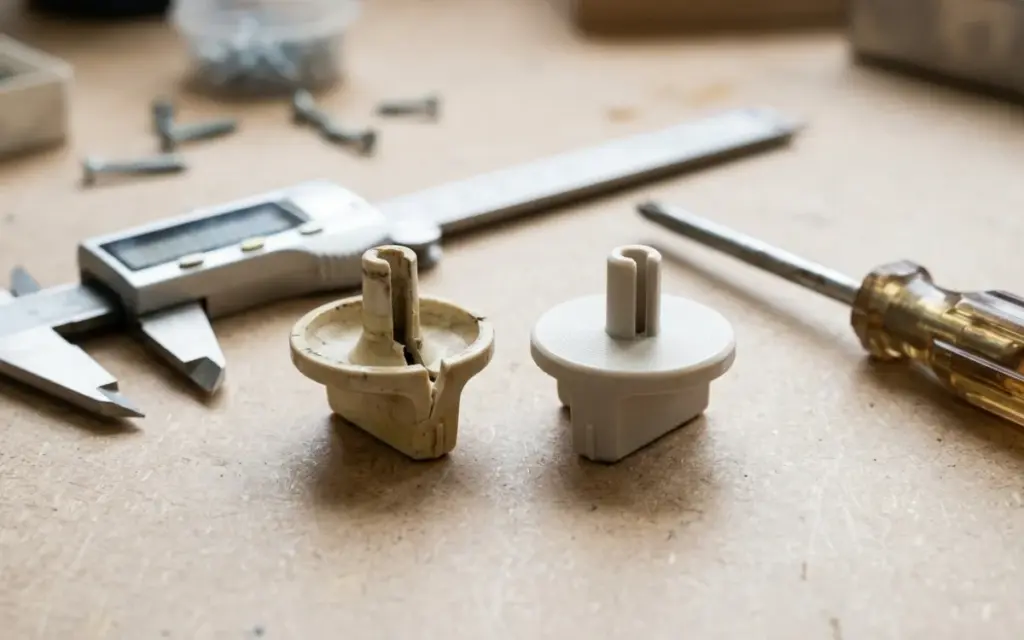
Why household appliances break and where to find spare parts
The washing machine stopped spinning because the plastic door handle cracked. The fridge has a shelf bracket torn out. The vacuum cleaner won’t work without the right attachment, which the manufacturer stopped making long ago. Sound familiar? Household appliances are designed to last 7–10 years, but small plastic parts often give out much sooner — and they’re what leave a perfectly good appliance sitting idle.
The problem is that finding an original spare part can be impossible. Manufacturers discontinue models, authorised service centres close, and universal alternatives either don’t fit or cost far too much. Buying a new washing machine because of a broken handle is absurd, yet thousands of people do exactly that because they don’t know there’s an alternative.
That alternative is 3D printing spare parts for household appliances — a technology that can recreate any broken part in a day or two, often for less than the original would cost. Custom spare parts printing has already helped hundreds of appliance owners in Lviv bring back to life machines that seemed fit only for the bin.
What can be repaired with 3D printing?
The range of appliances we print spare parts for is much wider than you might think. Here are the most common cases from our work:
Washing machines and dishwashers
The parts that break most often here are door handles, detergent drawer catches, feet and filter covers. In dishwashers — basket runners and wheels, plate holders and spray arm caps. These parts are under constant load and in contact with water and detergents, so over time they crack or deform. Original spare parts for Bosch or Siemens dishwashers can cost from 500 UAH for one small plastic wheel — a printed replacement costs several times less.
Fridges and freezers
Shelves, bottle holders, vegetable drawers, door handles — all of these are plastic parts that become brittle with age and temperature changes. Fridges more than 5 years old are especially vulnerable: the plastic becomes fragile, and a little force is enough to snap off a shelf bracket or a handle. 3D printing lets you recreate the part to the exact dimensions of your model — even if that fridge was discontinued long ago.
Vacuum cleaners and small appliances
For vacuum cleaners we print adapters between the tube and attachments, crevice tools in non-standard sizes, bag catches and compartment covers. For coffee machines — capsule holders, drip trays and portafilter handles. Battery covers for remote controls are a category of their own: they get lost all the time, and the only way to replace them is 3D printing, because manufacturers don’t sell them separately.
Furniture fittings and household bits
Although it’s not exactly appliances, furniture spare parts are one of the most popular requests. Hinges for plastic cabinets, furniture feet, shelf clips, pipe end caps — all of these break suddenly, and finding a replacement in a shop is almost impossible because every manufacturer uses its own unique fittings.
How the process works: from broken part to finished spare
Ordering a printed spare part is easier than it seems. The whole process takes four steps:
- Find a model. Search for a ready-made one by the appliance name and model on Printables, Thingiverse or MakerWorld. Can’t find one? We’ll tell you who can make it: a modeller will need photos of the broken part from different angles and its main dimensions (with a ruler or callipers), and if the part is lost — photos of where it fits.
- Send us the model. STL, OBJ, 3MF or STEP — via the form on the site, on Telegram, WhatsApp or by email. Within an hour during working hours we’ll give you the price and lead time and suggest a material.
- We print the part. Once the price and material are agreed, we start printing. Most appliance spare parts print in 2–6 hours, depending on size and complexity.
- You fit it and use it. We ship the finished part by Nova Poshta. Fitting usually needs no tools — the part goes where the original was.
Which material suits appliance spare parts?
The choice of 3D printing material is critical to how long the part lasts. For different operating conditions we recommend different plastics:
- PETG — for parts in contact with heat and moisture. It withstands up to +80°C and resists water and household chemicals. Ideal for spare parts for washing machines, dishwashers, coffee machines and fridges. It’s the most versatile choice for household repairs.
- PLA — for decorative and unloaded parts. It has a smooth surface, comes in dozens of colours and is easy to finish. It suits battery covers, end caps, decorative panels and furniture fittings — anywhere without high temperatures or mechanical loads.
- TPU — for flexible and sealing parts. An elastic material that doesn’t crack and returns to its original shape after deformation. Indispensable for gaskets, seals, cushioning feet, protective pads and any parts that need flexibility.
Not sure what to choose? Read our detailed comparison of PLA, PETG and TPU, or just describe the task — we’ll pick the best option.
How much does it cost, and is it worth it?
The exact price depends on the size, complexity and material of the part, but here are rough figures to give you an idea:
- Washing machine door handle — from 80–150 UAH (original — 400–800 UAH, if still on sale).
- Dishwasher basket wheels (set) — from 120–200 UAH (original set — from 500 UAH).
- Fridge shelf bracket — from 50–100 UAH (original — 200–600 UAH or unavailable).
- Vacuum cleaner attachment — from 100–180 UAH (buying an attachment separately is often impossible).
- Remote control battery cover — from 30–60 UAH (the alternative is buying a new remote for 300+ UAH).
Now compare that with the cost of a new appliance. A new washing machine — from 12,000 UAH. A new fridge — from 10,000 UAH. A new dishwasher — from 14,000 UAH. Even if modelling and printing cost 200–500 UAH, it’s a tiny fraction of the price of a new appliance. Read more about whether it makes economic sense in our article when 3D printing beats buying original parts.
Real repair examples from our work
A customer came to us with a 9-year-old Samsung washing machine. The plastic catch on the detergent drawer had broken — without it the drawer wouldn’t stay in and fell out every wash. The manufacturer no longer supplied the original part, and the service centre offered to replace the whole module for 2,800 UAH. We printed the catch in PETG for 90 UAH — the machine is still running.
Another case: the glass shelf bracket in a Liebherr fridge cracked in half — and the shelf with the food on it simply fell. The spare part for this model couldn’t be found in Ukraine. In a case like this, a modeller makes the model from photos of the broken bracket and measurements of where it fits, and the part can be printed in a day.
Another frequent request is feet and supports for kitchen appliances: microwaves, multicookers, toasters. A rubber foot gets lost — and the appliance stands unevenly and slides on the worktop. We print these parts in TPU — they’re soft, non-slip and durable.
Don’t throw away a working appliance because of one broken part
If a plastic part in your appliance has broken and you can’t find a replacement, 3D printing will almost certainly solve the problem. Send us a 3D model of the spare part via the form on the site — we’ll assess whether it can be printed for free, choose the material and work out the price. No model? We’ll tell you where to find a ready-made one (on Printables, Thingiverse or MakerWorld) or who can make it. Most parts are ready in 1–2 days with delivery across Ukraine.
Has a part broken on your appliance?
Send us the model — we’ll quote and print a replacement. No model? We’ll tell you where to find a ready-made one (on Printables, Thingiverse or MakerWorld) or who can make it. A free quote, fast printing, delivery across Ukraine.
Have an idea for something to print? Send a model or a photo of the part — we’ll quote it within an hour and suggest the right material.