3D printing in education — STEM projects for schools and universities
3D printing in education: why it changes the way we learn
Modern education needs new tools that help pupils and students not only memorise theory but also apply their knowledge in practice. 3D printing is exactly that kind of tool — it turns abstract concepts into real objects you can hold, explore and improve. In this article we look at how schools and universities bring 3D technology into STEM projects, what benefits it brings to students and where to start.
Why 3D printing matters for education
Traditional teaching often comes down to textbooks, presentations and abstract formulas. But not every pupil takes in information the same way — some need to see, or better still hold, what the lesson is about. This is where FDM 3D printing opens up new possibilities.
- Hands-on learning. Instead of looking at a picture of a crystal lattice, a pupil can print a model of it and study the structure from every side.
- Visualising abstract ideas. Mathematical surfaces, molecular structures, geographical relief — all become easier to understand as physical models.
- Motivation and engagement. When a pupil sees their idea become a real object, their interest in the subject and their desire to experiment grow.
- An interdisciplinary approach. One project can combine maths, physics, computer science and design — exactly what STEM education is built on.
STEM project ideas with 3D printing for schools
3D printing can be brought into almost any school subject. Here are specific examples of projects already running successfully in Ukrainian and European schools.
Maths: printing geometric solids and function graphs
Print 3D models of polyhedra, conic sections or graphs of complex functions. Pupils can turn the model around, measure faces and angles and compare volumes — far more effective than a drawing on the board.
Biology: models of cells and organs
A take-apart model of a plant or animal cell with separate organelles is a great way to explain how living organisms are built. More complex projects include models of the heart, the eye or DNA.
Geography: relief maps of an area
Using real topographic data, you can create a 3D map of your region, a mountain range or a river valley. Such a project combines geography with computer science and teaches working with data.
Physics: mechanisms and simple machines
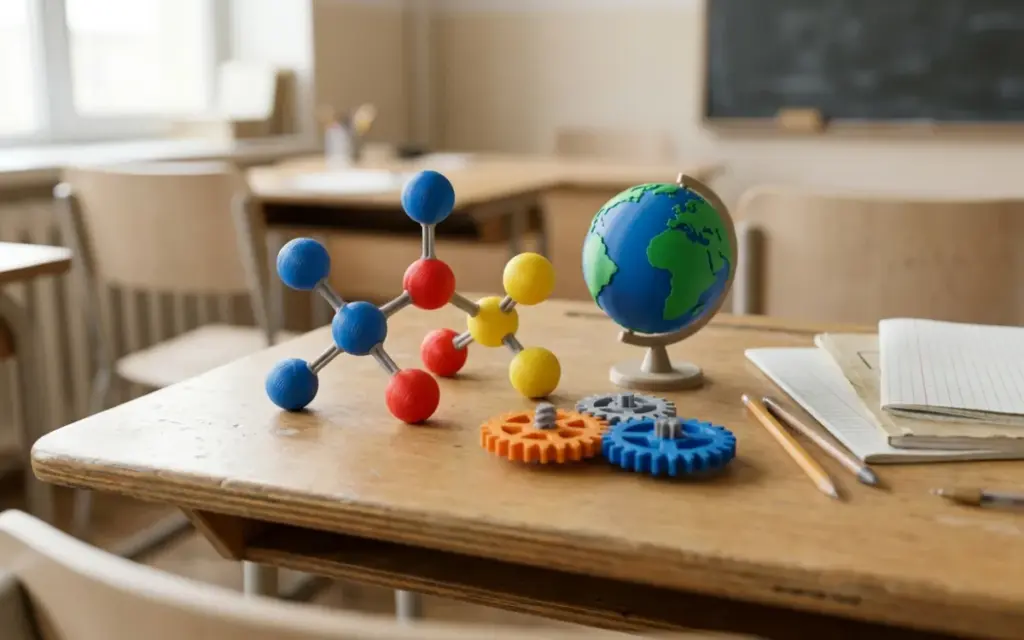
Printing gears, levers, pulleys and other mechanisms lets pupils understand the principles of mechanics in practice. You can build a working planetary gearbox or a model of a steam engine.
Chemistry: molecular structures
Models of water, methane, glucose or more complex organic molecules help explain the spatial structure of substances, types of bonds and isomerism.
How a school can start using 3D printing
Introducing 3D printing doesn’t require a big budget or special training. Here’s a step-by-step plan to get started.
Step 1: Choose a modelling program
Tinkercad is ideal for pupils — a free online tool from Autodesk. It has an intuitive interface, runs in the browser and needs no installation. Older pupils can move on to more advanced free 3D modelling programs such as Fusion 360 or Blender.
Step 2: Choose a safe material
For a school environment we recommend PLA plastic. It’s made from corn starch, gives off no toxic fumes when printed and is safe for children. Read more about the different types of plastic on the 3D printing materials page.
Step 3: Start with simple projects
Don’t try to print complex mechanisms straight away. Start with simple geometric solids, keyrings with pupils’ names or phone stands. This lets you master the technology and see the first results within a lesson or two.
Step 4: Order printing outside if you don’t have a printer
Not every school can afford its own 3D printer. In that case pupils create models on the computer, and printing can be ordered from a professional service. It’s cheaper than buying equipment and gives a quality result.
3D printing at university: from prototypes to research
At university level the possibilities of 3D printing are much wider. The technology is becoming an essential part of training engineers, architects, doctors and scientists.
Engineering prototyping
Engineering students can quickly print prototype parts, enclosures and mechanisms. This shortens the development cycle from idea to physical sample from weeks to a few hours. Mistakes are found early, and iterations cost very little.
Architectural models
Instead of laborious models made of cardboard and foam, architecture students create precise scale models of buildings. 3D printing reproduces complex shapes, curves and facade details that are hard to recreate by hand.
Scientific research
In laboratories, 3D printing is used to make sample holders, sensor housings, specialised tools and even microfluidic devices. This speeds up research and lowers its cost.
What skills 3D printing develops in students
Besides subject knowledge, working with 3D technology builds skills that are useful in any profession.
- Problem-solving. When a model doesn’t print correctly, you have to find the cause and fix it — this trains analytical thinking.
- Design thinking. Pupils go through the full cycle: from idea through design and prototyping to a finished product.
- Technical skills. Working with CAD programs, understanding material properties, the basics of engineering — all of this is a competitive advantage on the job market.
- Teamwork. STEM projects are often done in groups where everyone is responsible for their part: someone models, someone prepares the file for printing, someone presents the result.
- Creativity. 3D printing removes the limits of traditional manufacturing — pupils can bring almost any idea to life.
Ready to start? We’ll help print your teaching models
If you’re a teacher, a school administrator or a university lecturer and want to bring 3D printing into your teaching, we’re ready to help. Our service, 3dprint.lviv.ua, prints teaching models in safe materials at affordable prices. Send us the model file or describe what you need, and we’ll find the best solution. Get in touch to discuss your education project and get free advice.
Have an idea for something to print? Send a model or a photo of the part — we’ll quote it within an hour and suggest the right material.