ABS plastic for 3D printing — properties and applications
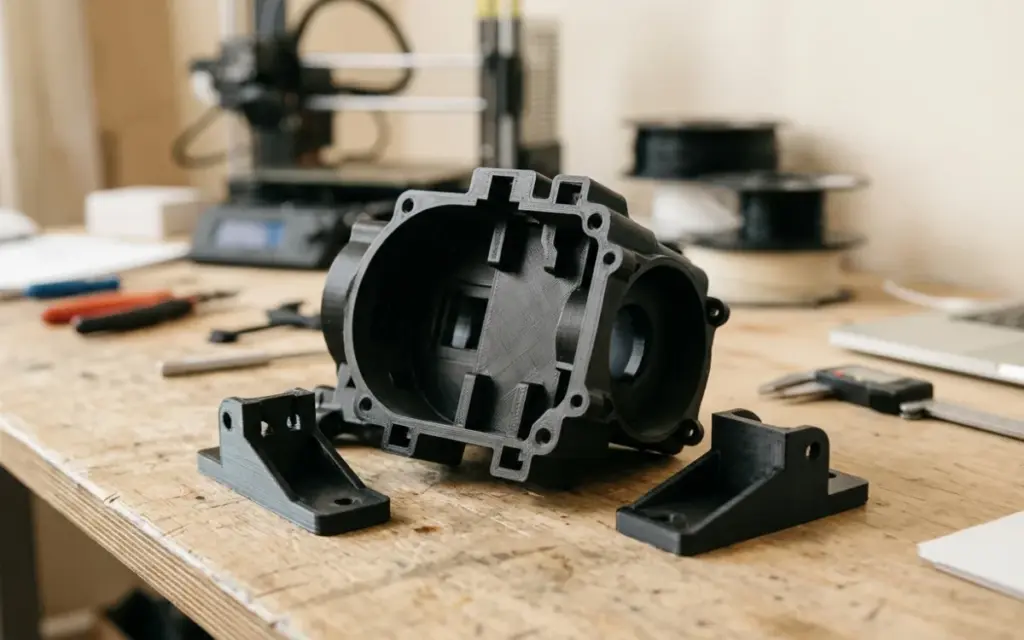
What ABS plastic is and why it’s popular in 3D printing
ABS (acrylonitrile butadiene styrene) is one of the oldest and best-known thermoplastics in 3D printing. It’s what LEGO bricks, household appliance housings and car parts are made of. Industry has used ABS for decades, and for good reason: the material combines strength, heat resistance and the ability to be finished well — things other popular filaments often lack.
If you’re choosing a 3D printing material and need a part that can take mechanical loads or high temperatures, or that needs a smooth surface, ABS is worth considering first. In this article we look at its key properties, compare it with the alternatives and explain which jobs it suits best.
Key properties of ABS plastic
Heat resistance
ABS withstands temperatures up to 100–110 °C without deforming. For comparison, PLA starts to soften at just 55–60 °C. This makes ABS indispensable for parts that work near heat sources: mounts in a car’s engine bay, electronics enclosures that run hot, parts of lighting fixtures.
Strength and impact resistance
ABS is a stiff but not brittle material. It absorbs impacts well thanks to the butadiene in its structure. Where PLA would simply crack, ABS deforms elastically and stays intact. This is critical for functional parts: protective covers, mechanical mounts, tool housings.
Moderate flexibility
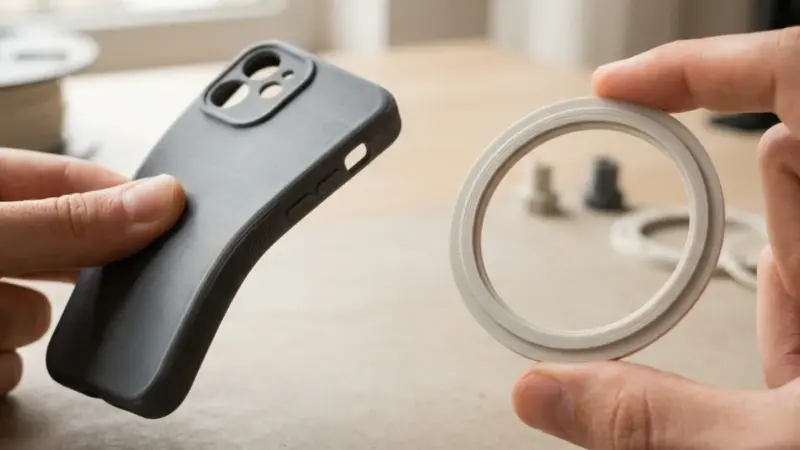
Unlike brittle PLA, ABS has a certain elasticity. This makes it possible to create clips, snap-fit joints and springy elements that won’t break after a few cycles of use. Of course, for truly flexible parts it’s better to choose TPU, but ABS has enough ductility for most engineering tasks.
Chemical resistance
ABS resists many acids, alkalis and oils. ABS parts can be used in contact with lubricants, fuel and household chemicals. That’s another reason the material is chosen for automotive and industrial applications.
ABS or PLA/PETG — when to choose which?
Each material has its niche. Here are practical guidelines to help you choose:
- PLA — the easiest to print, ideal for prototypes, decorative items and models that don’t take loads or heat. If the part will sit on a shelf, PLA is quite enough.
- PETG — a compromise between PLA’s ease of printing and ABS’s functionality. It has better heat resistance than PLA (up to 75–80 °C) and good impact resistance, but falls short of ABS when it comes to post-processing.
- ABS — the best choice when you need high heat resistance, mechanical strength and a smooth surface after finishing. It takes more experience to print.
Read more about the differences between materials in our comparison of PLA, PETG and TPU.
The challenges of printing ABS: what you need to know
ABS isn’t the easiest material for 3D printing, and you should take that into account when planning a project.
Shrinkage and warping
The main problem with ABS is significant thermal shrinkage. As it cools, the material contracts, which makes the edges of a part lift off the bed (warping) and cracks appear between layers (delamination). Large flat parts suffer from this the most.
An enclosed chamber — a necessity, not a luxury
Printing ABS well requires an enclosed printer chamber with controlled temperature. Draughts and sudden temperature changes are enemy number one. A chamber temperature of 50–65 °C significantly reduces the risk of delamination. Open printers without a chamber can cope with small parts, but for serious projects it’s a compromise with unpredictable results.
Fumes and ventilation
When printed, ABS gives off styrene — a substance with a strong smell that can be harmful in high concentrations. Printing ABS in a living space without extraction is a bad idea. You need either separate ventilation or a printer with a built-in air filtration system.
Recommended print settings
- Nozzle temperature: 230–260 °C
- Bed temperature: 90–110 °C
- Adhesion: ABS slurry (ABS dissolved in acetone), Kapton tape or a special adhesive
- Print speed: moderate, 40–60 mm/s
- Part cooling: minimal or off
Post-processing ABS — the material’s main advantage
When it comes to post-processing, ABS is unmatched among common filaments. Acetone smoothing is a technique that turns a layered 3D print into an item with a smooth, almost moulded surface.
The process is simple: the part is placed in an airtight container with acetone vapour for a few minutes. The surface dissolves at a micro level, the layers merge, and the part takes on a glossy look. The result isn’t just aesthetic: smoothing improves watertightness and strengthens the surface further.
Besides acetone smoothing, ABS is easy to:
- Sand and polish
- Drill and tap threads
- Glue (acetone works like welding for ABS)
- Paint with spray and acrylic paints
More about finishing techniques in our article on post-processing 3D parts.
Real-world applications of ABS in 3D printing
ABS isn’t a theoretical test material. It’s used in real projects every day:
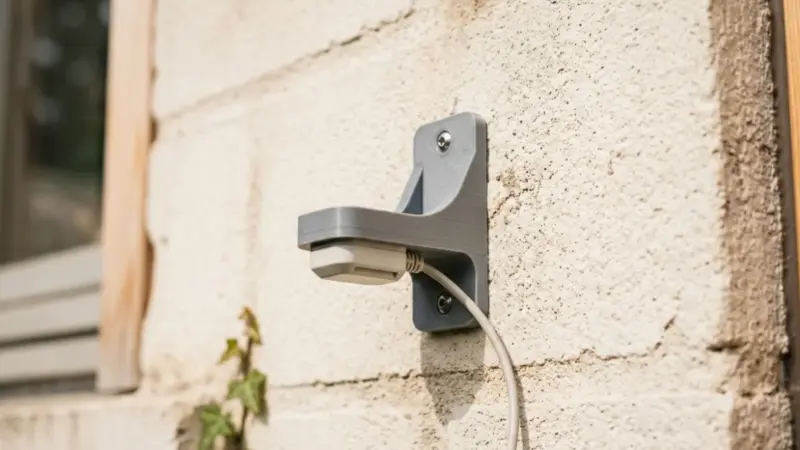
- Car parts: mounts, covers, air ducts, sensor holders — anything that works under the bonnet at high temperatures.
- Electronics enclosures: boxes for Arduino and Raspberry Pi boards, power supply housings, covers for LED drivers. ABS provides electrical insulation and heat resistance.
- Functional prototypes: parts that need testing in real conditions — under load, under vibration, in contact with chemicals.
- Tools and fixtures: templates, jigs and holders for production lines, where parts are subject to regular mechanical stress.
- Household items: things that come into contact with heat — soldering iron stands, hair dryer holders, coffee machine parts.
Who ABS suits, and when to choose a different material
Choose ABS if your part meets at least one of these criteria:
- It works at temperatures above 60 °C
- It takes impact or cyclic loads
- It needs a smooth surface after post-processing
- It’s in contact with oils, fuel or household chemicals
- It has clips, springy elements or snap-fit joints
Skip ABS in favour of other materials if you need easy printing without an enclosed chamber (choose PETG), the part is decorative and takes no loads (choose PLA), or you need food safety (ABS isn’t certified for food contact).
Order ABS 3D printing in Lviv
Printing ABS takes the right equipment, experience and control of the settings. If you have a project that needs strong, heat-resistant parts with a quality surface, we’ll help you bring it to life. We work with industrial printers with an enclosed, temperature-controlled chamber, which guarantees consistent quality even for large parts. Get in touch to discuss your project and get a quote.
Not sure which plastic to choose? Send the model and tell us where the part will be used — we’ll pick PLA or PETG and quote it within an hour.