3D printing for anglers: custom lures, tackle boxes and accessories
3D printing for anglers: from lures to rod holders
Fishing is a hobby where every detail matters. The wrong lip angle on a lure, an awkward tackle box, no decent rod holder on the boat — all of this affects your results and how much you enjoy the process. That’s why experienced anglers are turning to 3D printing more and more: being able to create any accessory exactly for your needs takes preparation to a whole new level.
In this article we look at what can be printed for fishing, which materials to choose and what to pay attention to when ordering.
Custom lures and baits: print what the shops don’t have
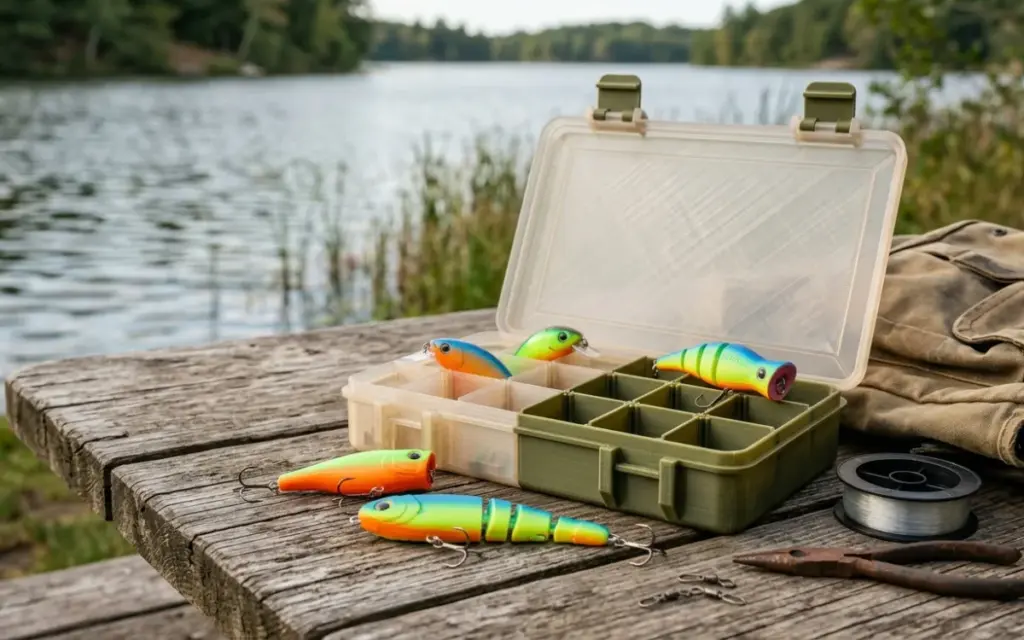
One of the most popular requests is making lures of your own design. 3D printing lets you experiment with the body shape, the angle and size of the lip and the position of the hook eyes. You can create a lure that imitates a specific baitfish from your local water or reproduce an expensive branded lure that’s no longer on sale.
What’s important to know:
- PETG is used for lures — it’s water-resistant, doesn’t swell and holds its shape well even after long periods in water.
- After printing, a lure needs to be sanded, weighted (to give it the right action) and painted.
- You can print hollow models with controlled buoyancy — from floating to sinking.
- Soft silicone-style baits (twister tails, paddle tails) can be printed in TPU — a flexible material that imitates the softness of real silicone.
Read more about the properties of each material in our comparison of PLA, PETG and TPU.
Tackle organiser boxes
Standard boxes from the shop rarely suit your tackle perfectly. Some fish with micro-jigs and need lots of small compartments; others carry big lures that don’t fit in any box. 3D printing solves this problem completely.
What you can make:
- An organiser with compartments made for your lures — each in its own place.
- Modular systems where sections connect to each other and are easy to rearrange.
- Boxes with latching or magnetic lids.
- Organiser inserts for boxes or bags you already have.
For organisers that don’t come into direct contact with water, PLA is perfectly suitable — it’s cheaper, prints well and gives a smooth surface. If the box will get wet (for example, for live bait), choose PETG. More about the available materials on a separate page.
Rod holders: for the boat and the bank
A rod holder is something that’s almost impossible to buy in a universal version. Every boat has different gunwales, tube diameters and angles. The bank has its own conditions: some fish from a jetty, some from a chair, some standing.
Boat holders
- Gunwale mounts with an adjustable angle.
- Holders for the rope rail (inflatable boats) — printed to the exact diameter of your rail.
- Multi-position racks for trolling.
- Spinning rod mounts on the transom next to the motor.
Holders for bank fishing
- Rod rests with non-standard angles.
- Buzz bars for a specific number of rods with precise spacing between them.
- Adapters for connecting standard bank sticks to non-standard parts.
PETG is recommended for all holders: it’s stronger than PLA, resistant to UV and moisture and copes with mechanical loads.
Reel seats and reel handles
The reel seat on your favourite spinning rod broke? The standard reel handle doesn’t suit you? 3D printing helps here too. You can make:
- A reel seat for the specific blank diameter of your rod.
- Custom reel handle knobs — ergonomically shaped to fit your palm.
- Adapters between different mounting standards.
These parts carry constant loads, so they’re printed in PETG with increased infill (80–100%) for maximum strength.
Rod stands, hook removers and floats
Stands for storage and transport
Besides holders for fishing, you often need stands for storing rods at home, in the garage or in the car. 3D printing lets you make a compact wall rack for exactly the number of rods you have or an insert for the car boot so spinning rods don’t knock against each other.
Hook removers
A simple but very useful accessory. It prints as a single part and needs no assembly. You can make a hook remover with a comfortable handle, a hole for a cord (to wear around your neck) and a grip shape optimised for the hook sizes you usually use. Material — PETG, since contact with water and fish is unavoidable.
Floats in non-standard shapes
Specific fishing conditions sometimes call for a float that simply isn’t on sale: extra heavy for strong currents, extra sensitive for still water, with an unusual antenna for better visibility. 3D printing in PETG or PLA (for calm fresh water) lets you create a float of any geometry and carrying capacity.
Fish finder mounts
A separate category is custom mounts for fish finders and their sensors. The standard mount supplied in the box rarely sits perfectly on a particular boat. With 3D printing you can make:
- A transom mount for the sensor (transducer) sized exactly for your boat.
- A holder for the fish finder’s head unit on the gunwale or a dedicated post.
- Protective housings that shield the sensors from hitting the bottom.
- Adapters between different mounting systems (for example, Garmin to a Lowrance-compatible post).
The material is PETG only: constant contact with water, sun and motor vibration demands maximum resistance.
Which material to choose: a quick cheat sheet
- PETG — for anything in contact with water or sun or under load: lures, holders, mounts, hook removers, fish finder mounts.
- PLA — for dry accessories: organisers, storage stands at home, templates.
- TPU — for soft and flexible parts: silicone-style baits, protective pads, shock absorbers.
You’ll find a comparison of these materials with their technical specifications in the article PLA vs PETG vs TPU.
How to order 3D-printed fishing accessories
The process is simple. If you have a ready-made 3D model (for example, one found on Thingiverse or Printables), send the file and we’ll work out the cost. If there’s no model, we’ll tell you where to find a ready-made one (on Printables, Thingiverse or MakerWorld) or who can make it. We’ll help you choose the material and print a part that really works on the water.
Need a custom fishing accessory?
Write to us — we’ll discuss your idea, choose the material and print exactly what you need. Go to contacts and order printing.
Have an idea for something to print? Send a model or a photo of the part — we’ll quote it within an hour and suggest the right material.