3D printing for musicians: accessories and instrument parts
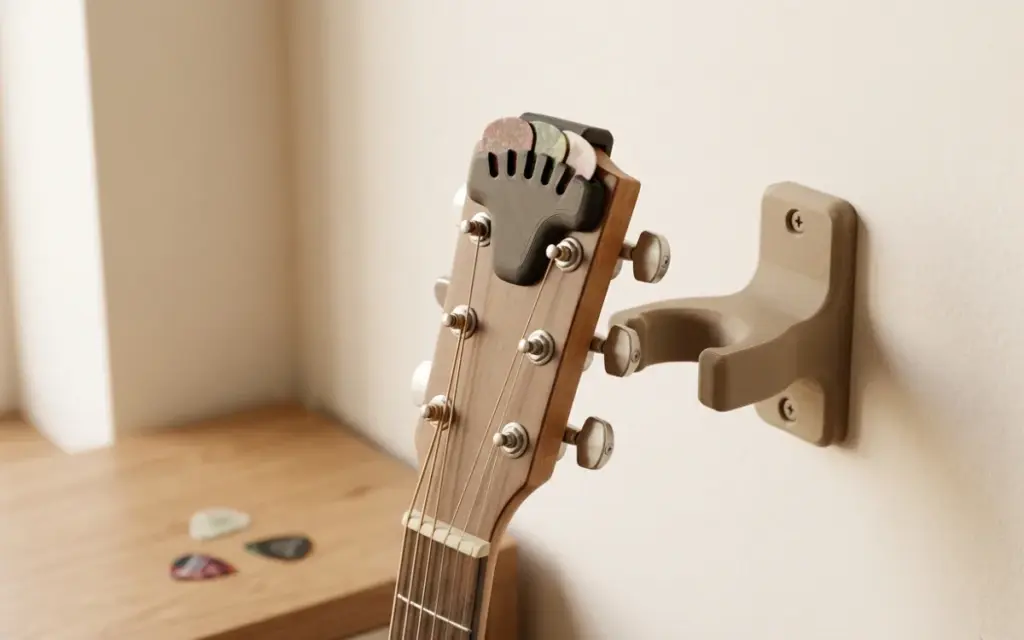
Music isn’t only talent and practice but also dozens of little things without which a rehearsal or gig turns into chaos. A lost pick, an awkward stand, cables tangling under your feet — sound familiar? 3D printing lets you create exactly the accessories you’re missing, in precise sizes, the right shape and at an affordable price. Let’s look at what can be printed for musicians and which materials work best.
Picks in custom shapes and thicknesses
Standard picks from a music shop suit most guitarists, but far from all. Some want a non-standard thickness, some an ergonomic shape with a thumb recess, and some a pick with an unusual surface texture for a better grip.
3D printing in PLA makes it quick to prototype different pick shapes and find the perfect one. You can experiment with:
- thickness from 0.5 to 3 mm;
- shape — from the classic teardrop to a triangle or asymmetric outlines;
- surface texture — ridges, dots, a band logo;
- a hole for attaching it to a lanyard or key ring.
It’s also a great gift for a musician — a personalised pick printed to an individual design.
Holders for sheet music and tablets
A classic music stand isn’t always convenient: it wobbles, won’t hold a tablet of the right size or takes up too much space. With 3D printing you can make:
- a compact tablet holder that attaches to a microphone stand;
- a clip for sheet music that stops pages turning in the wind at outdoor gigs;
- an adapter for attaching a phone to a music stand — handy for reading chords or recording rehearsals.
PLA works well for these items — it’s rigid enough, light and holds its shape well. If the holder will carry significant loads, choose PETG — it’s stronger and more impact-resistant. Read more about the differences between these materials in our comparison of PLA, PETG and TPU.
Stands for guitars, violins and ukuleles
A good instrument stand isn’t cheap, especially if you need a compact model for travel or a non-standard one for a ukulele or banjo. 3D printing solves this.
A desktop or floor stand printed in PETG supports the weight of most stringed instruments and is still easy to take apart for transport. PETG is the best choice for stands because it combines strength, moderate flexibility and resistance to temperature changes, which matters if you take the stand to outdoor gigs.
Besides full stands, you can print wall mounts for instruments — a compact solution for a home studio or rehearsal room where every square metre is worth its weight in gold.
Experimental mouthpieces for wind instruments
The mouthpiece is the heart of a wind instrument’s sound. Professional musicians spend years searching for the perfect mouthpiece, and 3D printing opens up new possibilities for experimenting. You can print a PLA prototype mouthpiece to test the cup shape, bore width and overall geometry before ordering an expensive brass version.
It’s important to understand that a printed mouthpiece is above all a tool for finding the ideal parameters, not a full replacement for a classic one. Still, it’s perfectly fine for learning, rehearsals and creative experiments.
Knobs for amplifiers and effects pedals
The original control knobs on guitar amps and effects pedals have a habit of getting lost or breaking. Finding an exact replacement for a vintage amp can be hard and expensive. 3D printing lets you reproduce the knob you need to the original’s dimensions or create a new one — bigger, more comfortable, with knurling for a better grip.
PLA is great for this job: knobs carry no significant mechanical load, and PLA’s smooth surface looks neat. If you like, you can choose different colours and give your gear a unique look.
Mounts for microphones and accessories
Standard microphone clips don’t always suit a particular microphone, and specialised mounts are unreasonably expensive. With 3D printing you can make:
- a clip made to your microphone’s exact diameter;
- an adapter for mounting a portable recorder on a stand;
- an adapter between different microphone stand thread standards;
- a headphone holder that clamps onto the edge of a desk or stand.
For mounts that carry regular loads we recommend PETG — unlike the more brittle PLA, it doesn’t crack with constant tightening and stretching.
Organisers for cables and pedals
A guitarist’s or bassist’s pedalboard is an ecosystem of its own where every centimetre counts. 3D printing is ideal for creating individual solutions:
- cable retainers that prevent tangling and accidental unplugging;
- mounts for non-standard pedals;
- risers that lift the back row of pedals for easier access;
- holders for power supplies under the pedalboard.
PLA works well for cable organisers — it’s rigid and holds cables in place. If some flexibility is needed, for example for clips that snap onto a cable, TPU is the better choice — an elastic material that doesn’t break when bent.
Protective covers for connectors
Dust and moisture are the main enemies of audio equipment. Protective covers for XLR, 6.3 mm jack or USB connectors on mixing desks, audio interfaces and amplifiers significantly extend the life of the gear. This is exactly where TPU shows its potential: elastic covers fit snugly on the connector, come off easily and don’t crack even after hundreds of uses.
TPU can also be used to print protective bumpers for effects pedals and portable recorders — they absorb knocks in transport and protect the casing from scratches.
Which material to choose: a quick cheat sheet
- PLA — for most accessories: picks, amp knobs, organisers, prototype mouthpieces. Easy to print, a smooth surface, a wide choice of colours.
- PETG — for parts that carry loads: instrument stands, microphone mounts, pedalboard parts. Stronger and more flexible than PLA.
- TPU — for elastic items: protective covers, bumpers, flexible clips. Doesn’t crack and absorbs impacts.
More about the properties of each material in our article PLA vs PETG vs TPU.
Ready to start?
If you have an idea for a music accessory or need a replacement part for an instrument or equipment, we’ll help bring it to life in plastic. Send us dimensions, photos or a 3D model, and we’ll choose the best material and print settings. Get in touch to discuss your project — from idea to finished item usually takes just a few days.
Important: we print only from a ready-made 3D model (STL, OBJ, STEP or 3MF). No model? We’ll tell you where to find a ready-made one (on Printables, Thingiverse or MakerWorld) or who can make it.
Have an idea for something to print? Send a model or a photo of the part — we’ll quote it within an hour and suggest the right material.