3D printing for camping and hiking: useful things for the trail
3D printing for camping and hiking: what to print for your trip
Anyone who has packed a rucksack for a hike knows that you can never have too many little things, and every gram counts. This is where 3D printing becomes a real helper — you can create dozens of useful items that suit your needs perfectly, weigh next to nothing and cost pennies compared with factory equivalents. In this article we look at specific items worth printing before your next trip into the outdoors.
Which material to choose: PETG or PLA
Before moving on to the list, it’s important to understand the materials. For outdoor gear, the choice of material isn’t just a question of looks but of safety and durability.
PETG is the main material for anything used outdoors. It’s UV-resistant, doesn’t become brittle in frost, copes with moderate mechanical loads and doesn’t deform in the sun even on a hot day. If an item has to last several seasons and work under load, print it in PETG.
PLA is suitable only for temporary or single-use items: prototypes you test before the final print, or items for a single trip. In direct sun PLA can soften at as little as 55–60 °C, and moisture gradually weakens it. So for serious gear — PETG only.
A torch mount for a tent pole
One of the most popular models among hikers. A small clip that snaps onto a tent or tarp pole and holds a torch, turning it into a proper camp lamp. It prints in 30–40 minutes, weighs up to 15 grams and solves the problem of lighting inside the tent. It’s worth making a few sizes for different pole and torch diameters.
Carabiners and hanging hooks
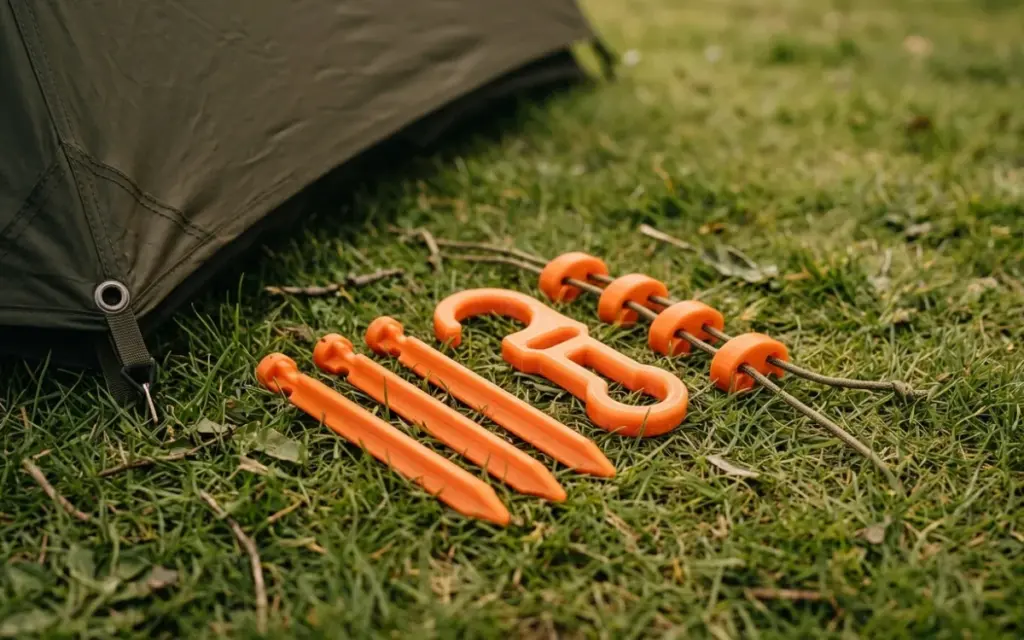
Printed carabiners won’t replace certified climbing equipment — it’s important to understand that. But for everyday camp needs they’re indispensable: hanging a towel on a line, clipping keys to a rucksack, hanging a food bag on a branch away from animals. S-shaped PETG hooks hold loads of up to 5–7 kg, which is quite enough for camp life.
A stove stand
Compact gas stoves often have a narrow base, and on uneven ground a pot of boiling water becomes a real hazard. A printed stabiliser stand widens the footprint, and some designs have a built-in windshield. Be sure to use PETG here — it copes with short-term heat much better than PLA. Of course, place the stand so the plastic doesn’t come into direct contact with the flame.
Mug and tableware holders
The eternal problem at camp is where to put a mug so it doesn’t tip over. A holder that pushes into the ground or clips onto a folding chair solves it elegantly. Another option is a hanging holder for the edge of a table that prints as a single part with no assembly. Little things like these make camp life much more comfortable.
An organiser for small items
Batteries, a lighter, a multitool, insect repellent, plasters — they all have a habit of spreading around the rucksack. A compact organiser with dividers, printed to fit your things exactly, brings order once and for all. You can make a modular system: several small boxes that connect to each other and come apart easily. One organiser for the first-aid kit, another for the repair kit, a third for electronics.
A winder for rope and paracord
Rope coiled loosely in a rucksack tangles with everything. A simple winder with an end lock lets you neatly wind up paracord, a washing line or even an LED strip. It prints in an hour and saves your nerves for the whole trip. You can make several winders in different sizes for different lengths of rope.
An emergency whistle
A small thing that can save a life. A printed PETG whistle doesn’t rust or break and can be heard several hundred metres away. Many hikers print a whistle with a built-in hole for a cord so they can wear it round the neck or attach it to a rucksack strap. It weighs literally 5 grams, and in an emergency it’s worth far more than the whole rucksack.
A multi-tool spoon-fork
The classic spork — a combination of spoon and fork — is one of the simplest and most useful things to print. More advanced versions include a serrated edge for cutting, a bottle opener or even a small spanner in the handle. PETG is a must, as the item will be in contact with hot food and constantly in the sun.
Tarp and awning clips
Factory tarp clips cost an absurd amount for a bit of plastic. Printed in PETG, they work just as reliably, and a broken clip can be reprinted in 20 minutes. There are models with different hole diameters for guy lines, with an extra hook or with a crocodile-style grip for fabric. Take a few spares on your trip — they weigh practically nothing.
Practical tips before printing
- Print with a wall thickness of at least 2 mm for items that work under load.
- An infill of 40–60% gives a good balance between strength and weight for outdoor gear.
- Always test items at home before the trip — check the fixings, the loads and how comfortable they are.
- Use bright colours — orange, yellow — so small parts don’t get lost in the grass.
- Make spares of critical parts: clips, carabiners, mounts.
Where to get models
Most of the items described can be found on Thingiverse, Printables or MyMiniFactory by searching for “camping clip”, “tent stake”, “spork” and so on. But the biggest advantage of 3D printing is that you can adapt a model to yourself: change the size to fit your torch, add an engraved name or combine several functions in one item.
If you don’t have your own printer, write to us. We’ll help you choose the best material and print as many parts as you need from your model. No model? We’ll tell you where to find a ready-made one (on Printables, Thingiverse or MakerWorld) or who can make it.
Getting ready for a trip?
Send us a list of the things you want printed or simply describe the task — we’ll pick the models, advise on material and make everything turnkey. We print in PETG, which stands up to any weather.
Have an idea for something to print? Send a model or a photo of the part — we’ll quote it within an hour and suggest the right material.