FDM vs SLA — comparing 3D printing technologies
Introduction: the two main 3D printing technologies
There are dozens of different 3D printing technologies, but two of them dominate the market: FDM (Fused Deposition Modeling) and SLA (Stereolithography). Each has its strengths and limitations, and the choice between them depends on the specific task. In this article we compare both technologies in detail so you can see which one better suits your needs.
In short: FDM works with melted plastic and SLA with liquid photopolymer resin. But behind this simple difference lies a whole range of differences in quality, cost, speed and applications.
How each technology works
FDM — printing with melted plastic
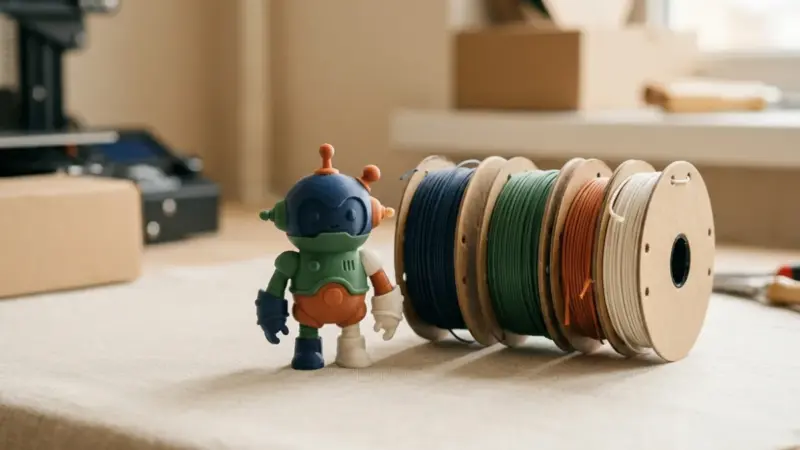
An FDM printer heats a plastic filament to its melting point and lays it down layer by layer on the build platform. The extruder moves along the X and Y axes, forming the outline of each layer; then the platform or the print head moves along the Z axis and the process repeats for the next layer.
Typical layer height: 0.1–0.3 mm. Nozzle diameter: 0.2–0.8 mm. Materials: PLA, PETG, ABS, TPU, nylon, polycarbonate and other thermoplastics.
SLA — printing with photopolymer resin
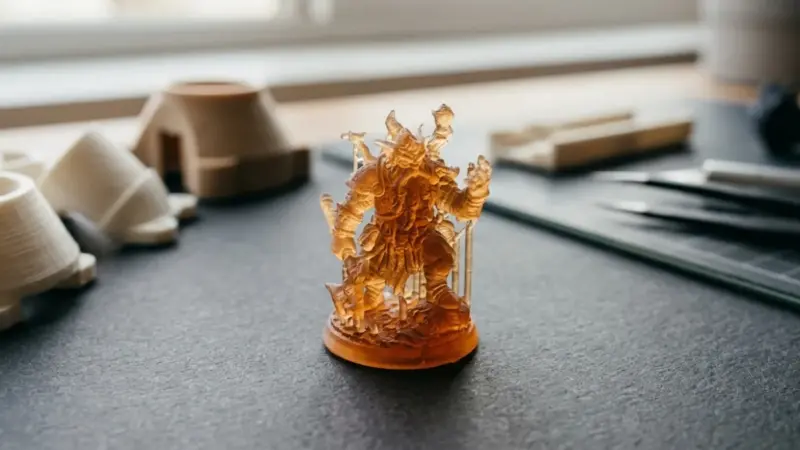
An SLA printer works differently: liquid photopolymer resin is poured into a vat and hardens under ultraviolet light. A laser (in classic SLA) or an LCD/LED panel (in MSLA/DLP) cures each layer according to a set pattern. The build platform gradually rises, pulling the part out of the vat.
Typical layer height: 0.025–0.1 mm. XY resolution: down to 0.035 mm. Materials: standard, engineering, flexible, castable and biocompatible resins.
Comparison by key parameters
Resolution and surface quality
SLA wins. Thanks to thinner layers and precise curing, SLA delivers much finer detail and a smoother surface. This is noticeable on small details, text, textures and organic shapes.
FDM parts have a visible layered structure, which can be reduced with thinner layers (0.1 mm) but only fully removed by post-processing (sanding, acetone smoothing for ABS).
Strength and functionality
FDM wins. The thermoplastics used in FDM printing have much better mechanical properties. PETG, ABS and nylon withstand considerable loads, impacts and temperatures. FDM parts can be used as fully functional components.
SLA resins are usually more brittle, more sensitive to UV and can degrade over time. There are engineering resins with improved properties, but they’re more expensive and still fall short of engineering thermoplastics.
Printing cost
FDM wins. Let’s look at the main cost components:
- Material: PLA filament costs from 5 UAH/g, PETG from 6 UAH/g. Photopolymer resin is 2–4 times more expensive per gram.
- Maintenance: FDM printers are easier to maintain. SLA needs regular replacement of the FEP film, resin filtering, washing parts in isopropyl alcohol and extra UV curing.
- Consumables: SLA needs isopropyl alcohol, gloves and filters — all of which add to the cost.
Print speed
It depends. New-generation FDM printers (Bambu Lab, Prusa Core) can print at up to 300–500 mm/s, which makes them quite fast for large parts. SLA printers, especially MSLA, cure a whole layer at once, so they can be faster for parts with a large cross-section.
In practice, FDM is fast enough for most typical orders — a medium-sized part prints in 3–8 hours.
Post-processing
FDM is simpler. After FDM printing, you just take the part off the platform and remove the supports (if any). If you like, you can sand and paint it.
SLA requires mandatory post-processing:
- Washing in isopropyl alcohol to remove uncured resin.
- Extra UV curing (post-curing) to reach the final mechanical properties.
- Removing supports and sanding where they were attached.
This process takes time and needs extra equipment and chemicals.
Safety and working conditions
FDM is safer. PLA plastic is non-toxic and doesn’t need special ventilation. SLA resins are toxic in liquid form, have a strong smell, and require gloves and good ventilation. This is an important factor, especially for home use.
FDM vs SLA comparison table
- Resolution: FDM — 0.1–0.3 mm | SLA — 0.025–0.1 mm
- Part strength: FDM — high | SLA — medium
- Material cost: FDM — from 5 UAH/g | SLA — from 20 UAH/g
- Speed: FDM — medium to high | SLA — medium
- Post-processing: FDM — minimal | SLA — mandatory
- Safety: FDM — high | SLA — requires care
- Maximum size: FDM — up to 50+ cm | SLA — usually up to 20 cm
- Best for: FDM — functional parts, enclosures, prototypes | SLA — miniatures, jewellery, dentistry
Which to choose: FDM or SLA?
The choice of technology depends on your specific task:
Choose FDM if you need:
- Functional parts under mechanical load
- Enclosures for electronics and IoT devices
- Prototypes to check dimensions and shape
- Large parts
- Spare parts for appliances
- An affordable price with good quality
Choose SLA if you need:
- Jewellery models for casting
- Highly detailed miniatures and figurines
- Dental products
- Parts with a very smooth surface without post-processing
Why FDM is the best choice for most tasks
The numbers speak for themselves: over 70% of all 3D printing orders are done with FDM. And that’s no accident. For the vast majority of practical tasks — prototyping, enclosures, spare parts, mounts and functional components — FDM offers the best combination of quality, strength and cost.
That’s why 3dprint.lviv.ua specialises in FDM 3D printing. This lets us offer customers the best quality at an affordable price, with a wide choice of materials for any task. Check our prices to estimate the cost of your project.
Summary
FDM and SLA aren’t competitors but tools for different jobs. FDM wins on strength, affordability, simplicity and versatility; SLA on detail and surface smoothness. For the vast majority of commercial and everyday tasks, FDM is the best solution.
Need quality 3D printing for your project? Get in touch — the 3dprint.lviv.ua team will help you choose the technology and material, prepare the model and produce the part exactly to your requirements.
Order 3D printing
Need quality 3D printing? printing materials. order 3D printing. prices. Delivery across Ukraine by Nova Poshta.
Want to test an idea for real? Send the model — we’ll print it in PLA or PETG and quote it within an hour.