How eco-friendly is PLA — is the bioplastic really green?
What PLA is and why it’s called a bioplastic
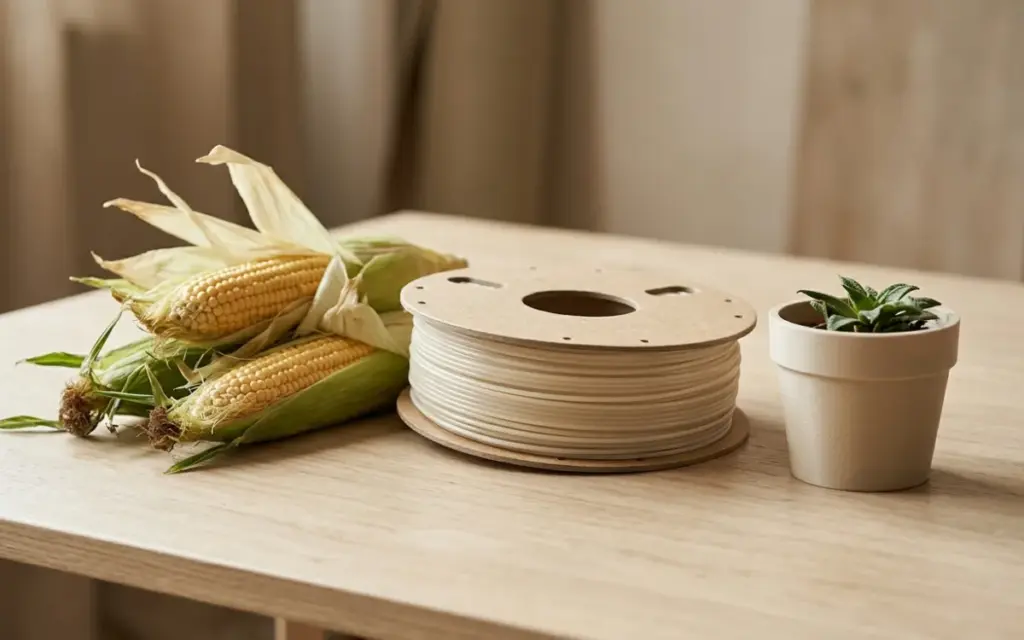
PLA (polylactide, or polylactic acid) is one of the most popular 3D printing materials, made from renewable plant-based raw materials: corn starch, sugar cane or cassava. Unlike traditional plastics (ABS, polyethylene, polypropylene), which are made from petroleum, PLA is plant-based, which is why it’s often called a “bioplastic” or “eco-plastic”.
But is PLA really as green as people say? In this article we look at the facts, the myths and the real environmental impact of this material — especially in the context of 3D printing.
Making PLA: from corn to a spool of filament
How PLA is made
PLA production has several stages:
- Growing the raw material — corn or other starchy plants are grown in fields
- Starch extraction — starch is extracted from the harvested plants
- Fermentation — bacteria turn the starch into lactic acid
- Polymerisation — lactic acid molecules link into long polymer chains, forming polylactide
- Filament production — PLA pellets are extruded into a strand (filament) 1.75 or 2.85 mm in diameter
Environmental advantages of production
Compared with making traditional plastics, producing PLA has significant advantages:
- A smaller carbon footprint: producing PLA generates 60–70% less greenhouse gas than ABS
- A renewable raw material: corn is grown every year, unlike oil, whose reserves are limited
- Lower energy use: polymerising PLA takes 25–55% less energy than producing petroleum-based polymers
There is a flip side, though: growing corn needs land, water, fertilisers and pesticides. Some critics point out that using crops to make plastic competes with food production.
PLA biodegradability: facts and myths
Myth: PLA breaks down in nature like ordinary leaves
This is the most common myth about PLA. Many people believe PLA items can simply be thrown away outdoors and they’ll decompose on their own. That’s not true.
PLA is indeed biodegradable, but it only breaks down under the specific conditions of industrial composting:
- Temperature: 55–70°C (much higher than in a home compost heap)
- Humidity: 80–90%
- Microorganisms: specific bacteria and enzymes
- Decomposition time: 2–6 months in industrial conditions
What happens to PLA in landfill
In an ordinary landfill, PLA behaves almost like traditional plastic. Without high temperatures and a controlled environment, decomposition can take 100 to 1,000 years. In cold water or soil, PLA stays practically unchanged for decades.
That’s why you must not just throw PLA items away outdoors — it’s still pollution.
Home composting
In home compost, PLA breaks down very slowly or not at all. A home compost heap rarely gets above 35–40°C, which isn’t enough to break PLA’s polymer chains effectively. Thin items may start to degrade after 1–2 years, but full decomposition is unlikely.
PLA vs ABS and other petroleum-based plastics
To judge how eco-friendly PLA is, let’s compare it with its main rivals in 3D printing:
PLA vs ABS
- Raw material: PLA is plant-based, ABS is petroleum-based. Advantage PLA
- Fumes when printing: PLA gives off far fewer toxic substances than ABS (styrene). Advantage PLA
- Printing energy: PLA prints at 190–220°C, ABS at 230–260°C. A lower temperature means less energy. Advantage PLA
- Durability: ABS is more resistant to UV and heat. In long-term use an ABS part lasts longer, which means less waste. Advantage ABS
- Recycling: both materials can be recycled, but the infrastructure for recycling ABS is better developed. A draw
PLA vs PETG
PETG (modified polyethylene terephthalate) is a compromise between PLA and ABS. It’s made from petroleum but is tougher and more durable than PLA. Environmentally, PETG is easier to recycle, as it belongs to the same group of polymers as drinks bottles (PET).
On the 3dprint.lviv.ua materials page you’ll find a detailed comparison of all the available printing materials, including their environmental properties.
Recycling PLA: options and limitations
Industrial composting
The most eco-friendly way to dispose of PLA is to send items for industrial composting. Unfortunately, the infrastructure for this in Ukraine is still limited. Big cities are gradually developing separate waste collection, but there are still few specialised facilities that compost bioplastics.
Mechanical recycling
PLA can be shredded and remelted for reuse. There are even special devices (filament extruders) that turn PLA waste into new filament for 3D printing. However, recycled material is usually of lower quality than the original.
Chemical recycling
The most promising direction is chemical depolymerisation, which breaks PLA back down into lactic acid for repolymerisation. This method produces PLA as good as virgin material, but for now it remains expensive and uncommon.
What to do with PLA waste at home
- Collect it separately — don’t mix PLA with other plastics
- Don’t throw it away outdoors — PLA won’t break down quickly
- Reuse it — failed prints can be remelted
- Look for collection points — some companies accept PLA waste for recycling
The environmental impact of 3D printing compared with traditional manufacturing
Whatever the material, 3D printing has several significant environmental advantages over traditional manufacturing methods:
- Minimal waste: additive manufacturing uses only as much material as needed. Traditional milling can turn up to 80% of the blank into chips
- Local production: a part can be printed on the spot, without being shipped across the ocean from a factory in China
- Made to order: no need for large batches and stockpiles. Only what’s needed gets printed
- Lighter parts: thanks to infill, 3D-printed parts are lighter than solid ones, which reduces fuel use in transport
- Repair instead of replacement: a broken part can be printed on its own, without buying a whole new product
At the same time, 3D printing uses electricity, and producing a kilogram of PLA filament has its own carbon footprint. That’s why it’s important to print responsibly.
Tips for environmentally responsible 3D printing
If you want to minimise the environmental impact of your 3D printing, follow these recommendations:
- Optimise your models — reduce infill to the minimum needed so you use less material
- Get it right the first time — calibrate the printer and check models before printing to avoid failed prints
- Choose PLA over ABS — when technically possible, prefer PLA for its smaller carbon footprint and lower toxicity
- Collect your waste — keep failed prints and supports for recycling
- Print only what you need — avoid printing for the sake of it. Every item should have a purpose
- Use responsible suppliers — choose filament manufacturers that follow environmental standards
- Order from professionals — professional print services optimise settings to minimise waste
Conclusion: PLA isn’t perfect, but it’s the better choice
PLA isn’t a perfect eco-material. It doesn’t break down in landfill, needs industrial conditions to compost, and its production has its own environmental footprint. Still, among the available 3D printing materials, PLA remains the most eco-friendly option: it’s made from renewable raw materials, takes less energy, gives off fewer toxins and is, in theory, fully biodegradable.
The key to green 3D printing is a responsible approach: optimising models, minimising waste and disposing of it properly. If you’d like to order 3D printing with an environmentally responsible approach, get in touch at 3dprint.lviv.ua. We’ll help you choose the best material and print settings so your part is high-quality and its environmental impact minimal.
Order 3D printing
Need quality 3D printing? 3D printing materials. order PLA printing. prices. Delivery across Ukraine by Nova Poshta.
Not sure which plastic to choose? Send the model and tell us where the part will be used — we’ll pick PLA or PETG and quote it within an hour.