3D printing for cosplay and props
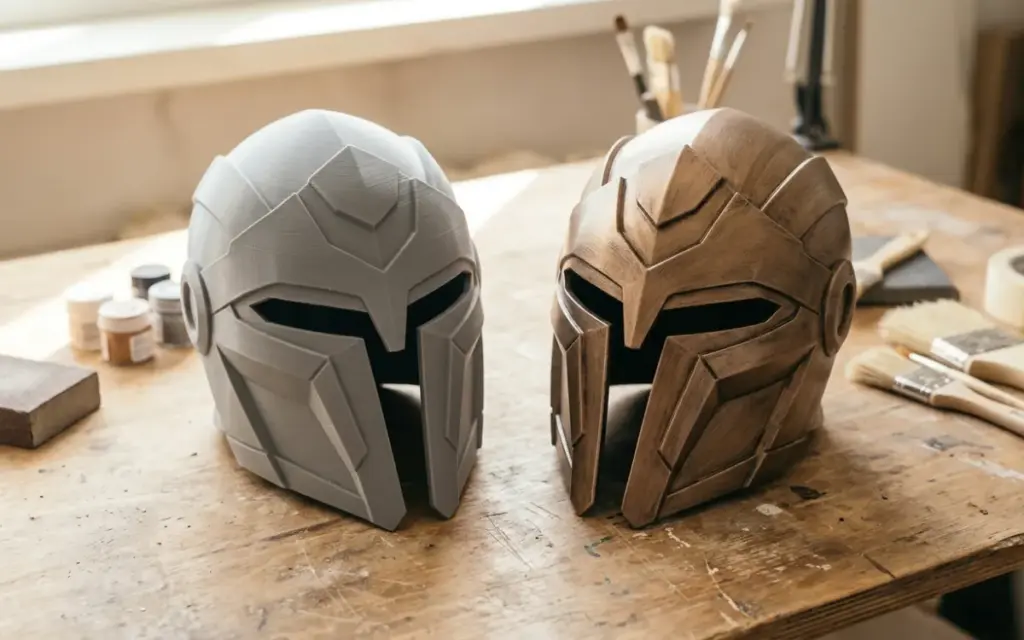
What cosplay is and why 3D printing is the perfect tool for it
Cosplay is the art of becoming characters from films, video games, anime and comics. A good costume needs parts you can’t find in ordinary shops: futuristic armour, fantasy weapons, complex masks and one-of-a-kind accessories. This is where 3D printing comes to the rescue for cosplayers.
Just a few years ago, making props meant months of handwork with foam, papier-mâché or fibreglass. Today, thanks to FDM printing, you can get an exact copy of any item from a game or film — from the Mandalorian’s helmet to a sword from Zelda — in a matter of days.
What you can print for cosplay
Armour and armour pieces
Chest plates, pauldrons, knee pads, gauntlets — all of these print beautifully on a 3D printer. The key advantage is being able to make parts that fit your body perfectly. Just adjust the 3D model to your measurements and you’ll get a costume that fits like a glove.
Helmets and masks
Helmets are among the most popular cosplay projects. They let you transform into a character completely. Stormtrooper helmets from Star Wars, a Batman mask, Master Chief’s helmet from Halo — all of these can be printed in high detail. Masks often combine rigid PLA with flexible TPU so they sit comfortably against the face.
Weapons and props
Swords, blasters, shields, magic staffs — 3D printing lets you recreate weapons from any franchise. Remember that cosplay weapons must be safe: they shouldn’t have sharp edges, and big events often require bright colour markings.
Accessories and small details
Belt buckles, medallions, pendants, badges, decorative costume elements — small details often create the very “wow factor” that sets a professional costume apart from an amateur one. 3D printing delivers high precision even for tiny elements.
How to split a large model for printing
Most cosplay models are too big to print in one piece. A helmet or chest plate simply won’t fit on the printer’s build plate. So models are split into parts — a process called splitting.
These programs are used to split models:
- Meshmixer — a free Autodesk tool, ideal for cutting models with planes
- Lychee Slicer — has built-in splitting tools with a key system
- Blender — a powerful 3D editor for more complex splitting
When splitting, it’s important to add a joining system — pins or slots that make the parts line up exactly during assembly.
Assembling and gluing the parts
After all the parts are printed, it’s time to assemble. Here’s a proven process:
- Clean-up — remove supports and sand the joints with 120–220 grit sandpaper
- Dry fit — put all the parts together without glue and check the seams
- Gluing — use superglue (cyanoacrylate) for PLA. For extra strength, apply epoxy resin to the inside of the seams
- Reinforcing seams — for large parts, use fibreglass or gauze with epoxy along the inner seams
Sanding and painting: from print to masterpiece
Sanding
To get rid of visible layer lines, the surface needs careful sanding. The recommended order:
- Coarse sanding — 80–120 grit sandpaper to remove large bumps
- Filler primer — fills in the fine layer lines
- Medium sanding — 220–400 once the filler has dried
- Final sanding — 600–800 for a smooth surface
Priming
Apply 2–3 thin coats of spray primer. This creates an even base for the paint and helps reveal defects that still need sanding.
Painting
Acrylic paints work best for cosplay props. They can be applied with a brush or an airbrush. Spray paint is handy for large surfaces. Finish with varnish — matte for a realistic look or gloss for a metallic effect.
Finishing techniques
Several techniques are used for a realistic look:
- Weathering (artificial ageing) — adds scratches and wear so the prop looks “battle-worn”
- Dry brushing — dragging a dry brush with paint over raised areas to bring out texture
- Wash — thinned dark paint that runs into recesses and creates shadows
Choosing a material for cosplay printing
The right material is the key to a successful costume. You can see the full range of printing materials on the materials page.
- PLA — the main cosplay material. Easy to print, sands and paints well. Ideal for armour, helmets and weapons. Its only drawback is that it can deform above 60°C, so don’t leave your costume in a hot car
- PETG — stronger than PLA and more heat-resistant. Suits parts under load
- TPU — a flexible material, indispensable for straps, padding, flexible mask parts and joints between rigid pieces
- ABS — smooths well with acetone, but is harder to print
Where to find cosplay models
There are plenty of resources with ready-made 3D models for cosplay:
- MyMiniFactory — a large catalogue of tested models, many of them free
- Gambody — a specialised shop of premium print models, including complex costumes and figures
- Thingiverse — the largest free library of 3D models
- Cults3D — paid and free models with a big cosplay community
- CGTrader — professional models that often need adapting for printing
If you need a unique model or help printing cosplay parts, turn to the professionals. The miniature and parts printing service at 3dprint.lviv.ua will help bring even the most complex ideas to life.
Tips for beginner cosplayers
- Start small — for your first project, choose a simple accessory rather than a full costume
- Do test prints — before printing a large part, print a small section to check the settings
- Mind the weight — a large helmet in solid PLA will be heavy. Use 10–15% infill and 2–3 mm walls
- Plan the fastenings — think in advance about how the costume stays on your body: straps, Velcro, magnets
- Document the process — photograph every stage; it helps with future projects and inspires the community
The cost of a cosplay project
The cost of 3D printing for cosplay depends on the scale of the project. A simple accessory may cost a few hundred hryvnias, while a full costume with armour can cost several thousand. But even in the most expensive case, 3D printing is usually cheaper than commissioning handmade work from a craftsman. Current printing prices are on the prices page.
Summary
3D printing has revolutionised the cosplay community, making studio-quality props possible at home. From simple accessories to full sets of armour, the possibilities are limited only by your imagination. The main thing is to be patient with post-processing, because it’s sanding and painting that turn a plastic part into a film-quality prop.
Want to create an impressive cosplay costume but don’t have your own printer? The 3dprint.lviv.ua team will help you print any parts for your cosplay — from tiny accessories to large armour pieces. Get in touch for advice on your project!
Order 3D printing
Need quality 3D printing? miniature printing. materials. prices. Delivery across Ukraine by Nova Poshta.
Have an idea for something to print? Send a model or a photo of the part — we’ll quote it within an hour and suggest the right material.