3D printing in medicine: from anatomical models to surgical instruments

3D printing in medicine: how additive technologies are changing the approach to treatment
3D printing moved beyond prototyping industrial parts long ago. Today it’s widely used in medicine — from preparing for complex operations to making individual orthopaedic devices. And importantly, most of these solutions are available not only to large clinics but also to small medical practices, private doctors and even students.
In this article we look at specific scenarios for using 3D printing in medical practice, suggest which materials suit each task and explain how to order the model you need.
Anatomical models for surgical planning
One of the most valuable uses of 3D printing in medicine is creating accurate anatomical models from computed tomography (CT) or magnetic resonance imaging (MRI) data. The surgeon gets a physical copy of a specific patient’s bone, organ or vascular system before the procedure begins.
This makes it possible to:
- Study the anatomy in detail in three dimensions, not just on flat images.
- Plan the sequence of steps during the operation.
- Rehearse the difficult stages of the procedure on the model.
- Show the patient what the upcoming procedure involves — this builds trust and understanding.
Printing in PLA is usually enough for such models — the material is inexpensive, reproduces geometry well and can be painted to highlight areas of interest. If high detail is needed (for example, small blood vessels or complex bone structure), it’s worth choosing SLA resin printing — it offers accuracy down to 0.05 mm.
Teaching models for medical students
Medical schools and continuing education courses need a large number of visual aids. 3D printing makes it possible to create accurate copies of organs, bones, joints and pathologies — at a much lower cost than traditional anatomical models.
The advantages of printed teaching models:
- Rare pathologies that aren’t in standard teaching sets can be reproduced.
- Models are easy to replicate — each student can work with their own copy.
- A broken or worn model can simply be reprinted.
- Different anatomical structures can be colour-coded.
PLA is optimal for teaching purposes — it’s safe, has no strong smell and comes in a wide range of colours. Read more about the properties of different plastics on the 3D printing materials page.
Surgical guides and templates
Surgical guides are individual templates that are fixed to the patient’s anatomy during an operation and show the exact position and angle for drilling, cutting or placing an implant.
They are most often used in:
- Maxillofacial surgery.
- Implantology and dentistry — for accurate positioning of dental implants.
- Orthopaedics — in osteotomy and when fitting fixation devices.
Accuracy is critical for guides, so SLA printing is recommended here. Medical-grade resins achieve the required geometric fit and may also be compatible with autoclave sterilisation (depending on the type of resin).
An important note on sterilisation
Not every 3D-printed item can be sterilised by standard methods. PLA deforms at temperatures above 60 °C, so for items that will come into contact with the surgical field, either special resins or PETG, which withstands temperatures up to 80 °C, are used. We’ll help you choose the best material for each specific case.
Dentistry: jaw models, aligners, templates
In dentistry, 3D printing is replacing plaster impressions: the mouth is scanned and a jaw model is printed from the digital data. Such models are needed to:
- plan orthodontic treatment — braces and aligners;
- make temporary crowns and bridges;
- produce surgical templates for implant placement;
- show the patient the treatment plan.
Clear aligners rely on printing too: after the dental arch is scanned, software breaks the tooth movement into stages, a model is printed for each one, and a clear tray is formed on it.
Important: FDM printing with plastic filament is suitable for planning and teaching models, prototypes, external orthoses and device housings. Implants and items in contact with tissue inside the body are made with other technologies — SLA, SLS or metal printing — from certified biocompatible materials.
Orthopaedic devices: splints, orthoses, braces
3D printing makes it possible to produce individual orthopaedic devices adapted to a specific patient’s anatomy. Unlike standard mass-produced items, printed orthoses follow the shape of the limb perfectly, providing better support and comfort.
Typical items:
- Immobilisation splints as an alternative to plaster — lighter, with ventilation holes, water-resistant.
- Orthoses for supporting joints during rehabilitation.
- Custom insoles based on a 3D scan of the foot.
The best material is PETG. It’s stronger than PLA, has some flexibility, is resistant to moisture and sweat and copes with moderate mechanical loads.
Temporary prostheses and functional assistive devices
3D printing doesn’t replace full prosthetics, but it can quickly create a temporary prosthesis for a patient waiting for a permanent one. This is especially relevant for children’s prosthetics — children grow quickly, and being able to print a new prosthesis promptly at minimal cost is a significant advantage.
Besides prostheses, 3D printing is useful for making assistive devices:
- Cutlery adapters for people with limited motor skills.
- Ergonomic handles for tools.
- Aids for holding medicines and dispensers.
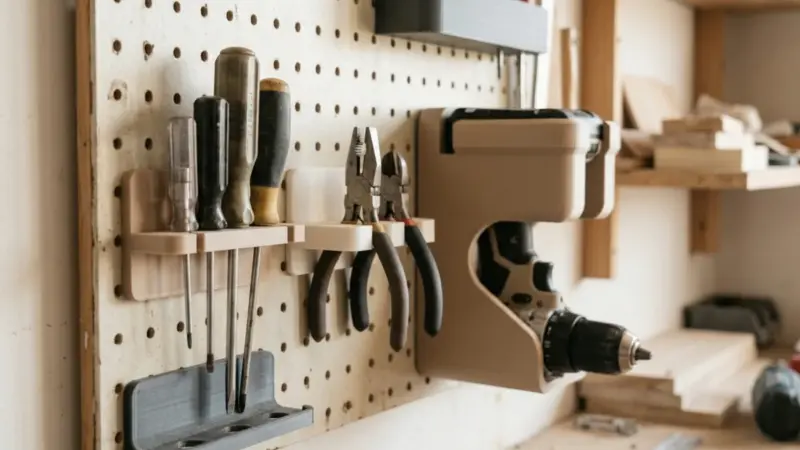
Holders for medical instruments and custom equipment mounts
Hospitals and clinics often need non-standard solutions for organising the workspace. Off-the-shelf holders don’t always suit specific equipment or the layout of a room. 3D printing solves this problem:
- Custom holders for probes, sensors, endoscopes and other instruments.
- Mounts for monitors, tablets and cameras in specific positions.
- Organisers for surgical instruments, adapted to a particular set.
- Adapters between different equipment mounting systems.
PETG is mostly used for these items — it’s strong enough, resistant to disinfectants and has a smooth surface that’s easy to clean.
Which material to choose: a quick guide
- PLA — teaching and demonstration anatomical models, mock-ups, presentation pieces. The most affordable option with good detail.
- PETG — functional items, orthopaedic devices, holders, mounts. Higher mechanical and chemical resistance.
- SLA (photopolymer resin) — surgical guides, high-precision anatomical models, dental items. The highest accuracy and surface quality.
A detailed description of each material, its properties and applications is on the materials page.
How to order 3D printing for medical needs
If you have a ready-made 3D model (STL, OBJ, STEP), send it to us and we’ll choose the best material and printing technology. If you only have medical data (DICOM files from CT or MRI), we’ll tell you who can convert them into a print-ready 3D model.
We work with individual doctors and clinics as well as with educational institutions. Special terms apply to batch orders (for example, a set of teaching models for a department).
Need 3D printing for medical use?
Describe your task — we’ll advise on technology and material and work out the cost. The consultation is free.
Have an idea for something to print? Send a model or a photo of the part — we’ll quote it within an hour and suggest the right material.