How to store 3D printing filament properly
Why storing filament properly matters
The quality of 3D printing doesn’t depend only on the printer settings or the model. One of the most common but often underestimated factors is the condition of the filament. Most thermoplastics used in FDM printing are hygroscopic, meaning they actively absorb moisture from the air. Even a few days in the open can noticeably worsen a material’s properties.
When damp filament enters the printer’s hotend, the water turns to steam at high temperatures. This causes micro-explosions inside the nozzle that disrupt the structure of the extruded plastic. The result is poor layer adhesion, brittle parts and unpredictable behaviour during printing. That’s why storing filament properly isn’t just a recommendation but a must for anyone who wants consistently good results.
Signs that filament has absorbed moisture
Before talking about storage methods, it’s important to learn to recognise damp filament. Here are the main symptoms:
- Crackling and popping during printing — the characteristic sounds of moisture evaporating in the hotend. This is the most obvious sign, audible even from a distance.
- Excessive stringing — thin threads of plastic appear between parts of the model where they shouldn’t be.
- A rough, uneven surface — instead of smooth layers you see a porous, lumpy texture.
- Bubbles and pits — small holes and swellings caused by evaporating water are visible on the surface.
- Poor layer adhesion — the part delaminates easily and becomes brittle and fragile.
- Colour change — some materials change shade after prolonged contact with moisture.
If you notice these problems but haven’t changed the printer settings, damp filament is most likely the cause. Read more about typical problems in our article on 3D printing mistakes.
Which materials are most sensitive to moisture?
Not all filaments react to moisture the same way. Here’s a ranking of sensitivity — from the most hygroscopic to the least:
- Nylon (PA) — the absolute leader in moisture absorption. It can take up to 9% moisture by weight. Nylon must be dried before every use and stored only in airtight packaging. More about this material in our guide to nylon for 3D printing.
- TPU and other flexible materials — also very sensitive to moisture, though less so than nylon.
- PETG — moderately hygroscopic. It absorbs moisture more slowly, but the effect on print quality is still significant.
- PLA — the least sensitive of the popular materials, but even it degrades when stored in the open for a long time.
You can compare the properties of different materials in more detail in our article PLA vs PETG vs TPU. And a full overview of the available options is on the 3D printing materials page.
Ways to store filament
Vacuum bags with silica gel
The simplest and most affordable method. After use, put the spool in a vacuum bag together with the silica gel (desiccant) sachets that come with most filaments. Use a household vacuum sealer to pump out the air — and the spool will be reliably protected from moisture for months.
Dry boxes
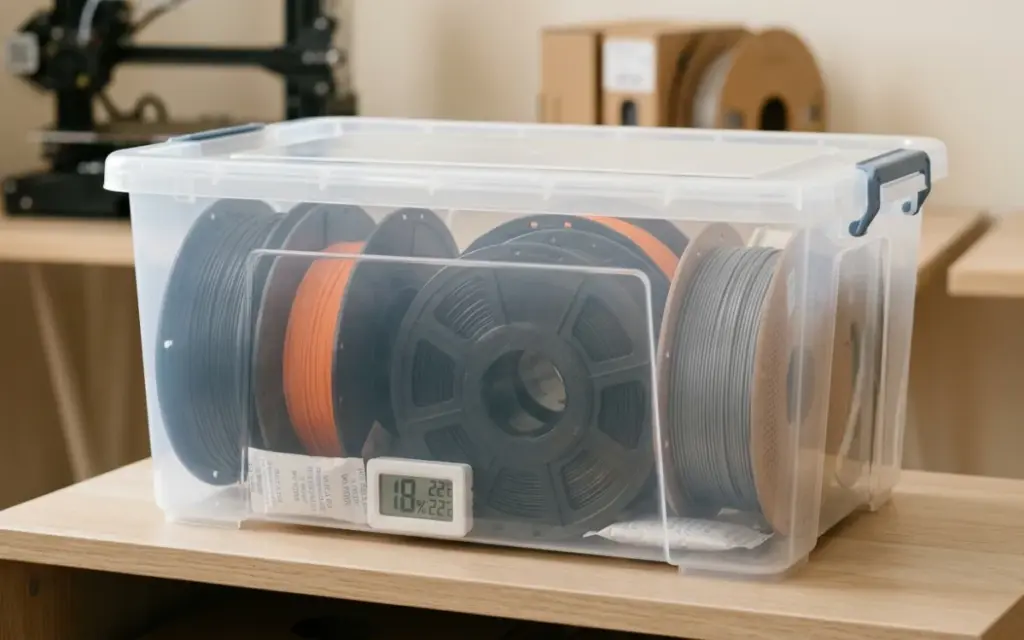
Airtight containers with a sealed lid are a more convenient solution for those who print regularly. Silica gel goes at the bottom of the container and the spools inside. Some models let you feed filament straight from the box into the printer through a special hole, so the material stays protected even during printing.
Filament dryers
Specialised devices such as the eSun eBOX, Sunlu FilaDryer or Polymaker PolyBox combine a dry box and a dryer. They hold a set temperature and can be used both for drying and for storage during printing.
How to dry damp filament
If filament has already absorbed moisture, it can be rescued by drying. The key is to stick to the right temperatures so you don’t deform the spool or melt the plastic.
Recommended drying temperatures
- PLA — 40–45°C for 4–6 hours
- PETG — 60–65°C for 4–6 hours
- TPU — 50–55°C for 4–6 hours
- Nylon (PA) — 70–80°C for 6–12 hours
- ABS — 60–65°C for 4–6 hours
- ASA — 60–65°C for 4–6 hours
Drying in an ordinary oven
A household oven can be used for drying, but with care. Most ovens have a temperature error of 5–15°C, so always use a thermometer to check. Set the lowest temperature and keep the door slightly open for air circulation. Remember: spools made of ABS or PLA plastic (not to be confused with ABS/PLA filament) can deform if overheated.
Specialised dryers
A more reliable option is a dedicated filament dryer or even a food dehydrator. They give precise temperature control and even airflow, which is much more effective than an oven.
Recommended humidity levels
For optimal filament storage, the relative humidity (RH) should be:
- Ideal — below 15% RH (in vacuum packaging with silica gel)
- Good — 15–25% RH (in a dry box with desiccant)
- Acceptable for PLA/ABS — up to 30% RH
- Critical — above 40% RH (nylon and TPU will start to degrade quickly)
To monitor humidity, we recommend placing a small digital hygrometer inside the storage container — so you can react to changing conditions in time.
Tips for long-term storage
- Always put the spool back in airtight packaging straight after printing; don’t leave it on the printer overnight.
- Regenerate silica gel: most sachets can be “recharged” by heating them in an oven at 120°C for 2 hours.
- Write the opening date on every spool — it helps you track how long the material has been exposed to air.
- Keep filament out of direct sunlight — UV breaks down polymers, especially PLA.
- Don’t store different types of material together unpacked — some can give off substances that affect other polymers.
- If you won’t use a spool for more than a month, be sure to vacuum-pack it.
How professional services store filament
In professional 3D printing studios, storing materials is a systematic process. Filaments are kept in special dry cabinets with humidity control, where RH is automatically held at 10–20%. Before each order, materials are checked and, if needed, dried in industrial dehydrators.
This is one of the reasons parts printed by professional services often look noticeably better than home prints. Controlling material moisture is just one of the many aspects that ensure a consistent result on every order.
Summary
Storing filament properly is a simple but critically important habit for every 3D printer owner. Vacuum bags, silica gel, airtight containers and timely drying will help you avoid most print quality problems. Even a small investment in organising storage will pay off in saved material and consistently high-quality parts.
If you don’t want to worry about storing materials and want a guaranteed quality result, order 3D printing from our studio. We control every stage of production, including filament storage conditions, so your parts always meet the highest quality standards.
Don’t want to prepare the file yourself? Send the model as it is — we’ll check it, fix any errors and quote it within an hour.