SLA resin 3D printing: when you need maximum detail
When standard FDM printing can’t deliver the surface quality or fine detail you need, SLA technology comes to the rescue. Stereolithography makes it possible to create models at a resolution filament printers can’t reach. In this article we look at how SLA printing works, which resins exist, where the technology is indispensable and what you should know before ordering.
How SLA printing works: the principle of photopolymerisation
SLA (stereolithography) is an additive technology in which a liquid photopolymer resin hardens under ultraviolet light. Unlike FDM, where a plastic filament is melted and laid down layer by layer, here a laser or UV projector selectively exposes a thin layer of liquid resin, turning it into solid plastic.
There are several variants of the technology:
- SLA (laser stereolithography) — a laser beam traces the outline of each layer in turn. It gives high accuracy but prints more slowly.
- DLP (Digital Light Processing) — a projector exposes the whole layer at once, which speeds up the process considerably.
- MSLA (Masked SLA) — an LED array with an LCD mask. The most common option in modern desktop printers thanks to its balance of speed and quality.
Whatever the variant, the principle is the same: the build platform lowers into a vat of resin, the UV source exposes the required areas, and the model forms layer by layer from the bottom up. A single layer is usually 25 to 100 microns thick — several times thinner than in FDM printing.
Types of photopolymer resin
The choice of resin directly affects the properties of the finished part. Here are the main categories we work with:
Standard resin
The most common and most affordable option. Suitable for visual prototypes, miniatures and decorative pieces. It has a smooth surface and good detail but is fairly brittle under impact.
Engineering resin
Resins with increased strength, heat resistance or elasticity. They include ABS-like resins that mimic the properties of ABS plastic and high-temperature resins for parts that will work under heat. The ideal choice for functional prototypes and end-use parts.
Flexible resin
Stays elastic after curing, resembling rubber or silicone. Used for gaskets, dampers, soft pads and prototypes of rubber products. More about the available options on the materials page.
Castable resin
A specialised resin for jewellery and art casting. It burns out in a kiln without leaving ash, so the printed model can be used as a master pattern for investment casting. This is a revolution in jewellery making — instead of hand-carving wax, the designer creates a 3D model and gets an exact wax-like copy.
Resolution and detail: what to expect
SLA’s main advantage is its ability to reproduce the finest details. Here are the key parameters that determine print quality:
- Layer thickness (Z axis) — 25 to 100 µm. For comparison: in FDM the minimum thickness is usually 100 µm and the working thickness 200 µm.
- XY resolution — determined by the pixel size of the LCD array or the diameter of the laser beam. Modern MSLA printers offer a 35–50 µm pixel.
- Minimum feature size — in practice, features from 0.1 mm can be reproduced: thin walls, fine relief, small text.
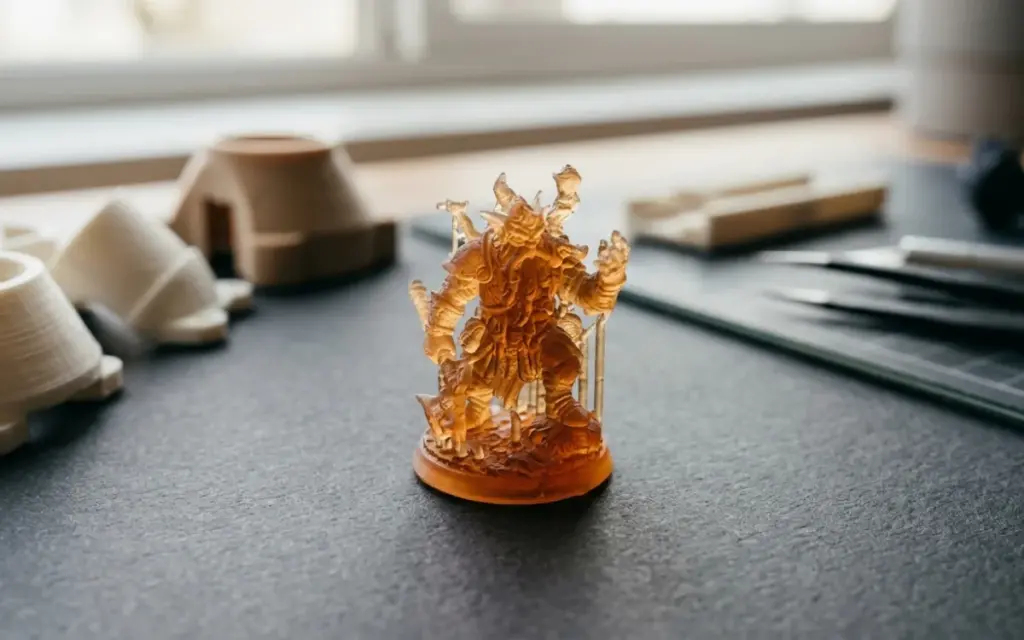
This means that an SLA print clearly shows the skin texture on a figurine, micro-relief on an enclosure prototype or the thin filigree of a piece of jewellery. Such details are simply impossible in FDM printing — read more about the differences between these technologies in a separate article.
Post-processing SLA prints: washing and curing
Unlike FDM, where a part is practically ready after printing, SLA models always need post-processing. It has two consecutive stages:
Washing
A freshly printed part is coated in leftover liquid resin. It has to be washed in isopropyl alcohol (IPA) or a dedicated solution for 3–10 minutes. This removes uncured resin from the surface and from internal cavities. If you skip this stage, the surface stays sticky and the geometry can distort.
UV curing
After washing, the part is placed in a special UV chamber for final hardening. The ultraviolet light completes polymerisation, increasing the model’s strength and stability. Curing time depends on the type of resin and the size of the part — usually 5 to 30 minutes.
After curing, the support structures are also cut away, their attachment points sanded and, if needed, the part is painted or varnished.
Pros and cons of SLA compared with FDM
Advantages of SLA
- Much higher detail and a smoother surface
- Thinner layers — practically invisible layer lines
- The ability to print miniature features and complex geometry
- A wide choice of specialised resins for different tasks
- Isotropy — the same strength in every direction
Disadvantages of SLA
- A smaller build volume — large parts have to be printed in pieces
- Higher material and printing costs than FDM
- Mandatory post-processing (washing, curing)
- Most standard resins are brittle and sensitive to UV light
- The need to handle chemicals (resin, isopropyl alcohol)
SLA doesn’t fully replace FDM — they are different tools for different jobs. If you need a large functional part in tough plastic, FDM will be the better choice. But when accuracy and surface quality come first, SLA has no equal.
Where SLA 3D printing is used: typical fields
Jewellery
Castable resins make it possible to create master patterns for casting with an accuracy that hand modelling can’t achieve. Jewellers print rings, pendants and earrings and then cast them in gold or silver.
Dentistry
Surgical guides, temporary crowns, aligners, jaw models for surgical planning — dentistry has become one of the biggest users of SLA printing thanks to biocompatible resins and high accuracy.
Miniatures and collectible figures
Board games, collectible models, character figures — SLA captures the finest details of faces, clothing and weapons. That’s why the technology has become the standard in the modelling community.
Prototyping
Visual and functional prototypes of electronics enclosures, medical devices and consumer products. SLA lets you assess ergonomics, check fits and present a product to a client before it goes into production.
Industry and engineering
Moulds for low-volume casting, precise gauges and templates, parts for wind-tunnel testing — engineering resins extend SLA’s capabilities far beyond prototyping.
Order SLA 3D printing in Lviv
If your project needs maximum detail, a smooth surface or specialised materials, SLA printing will be the best solution. We’ll help you choose the type of resin, optimise the model for printing and ensure quality post-processing.
Send your 3D model or describe the task — we’ll work out the cost and lead time. You can order SLA 3D printing through the form on the website or by contacting us directly.
Want to test an idea for real? Send the model — we’ll print it in PLA or PETG and quote it within an hour.