3D printing in veterinary medicine: prostheses, orthoses and tools for animals
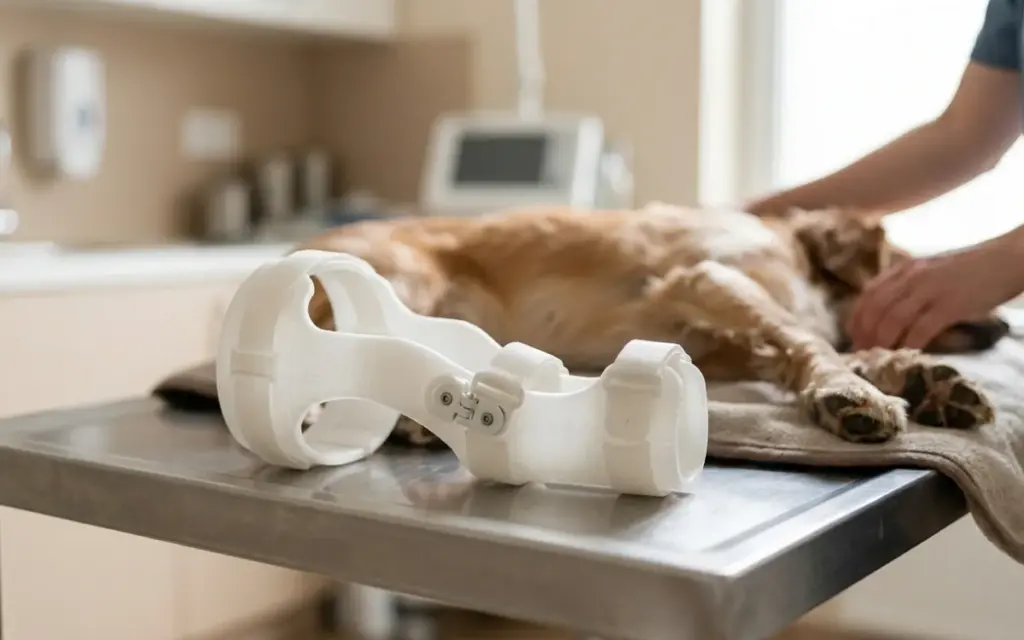
3D printing in veterinary medicine: how technology is changing animals’ lives
Veterinary medicine is developing fast, and 3D printing is becoming one of its most promising directions. Where making custom prostheses or surgical instruments for animals used to be extremely expensive and slow, additive technologies now make it possible to produce precise, functional items in a matter of days. Let’s look at the main areas where 3D printing is already helping vets and their patients.
Paw prostheses: giving an animal back its mobility
Losing a limb isn’t the end. Dogs, cats, rabbits and even birds get a second chance thanks to printed prostheses. The process starts with a scan or precise measurements of the stump, after which a digital 3D model tailored to the specific animal is created. The prosthesis goes through several fitting iterations so the animal gradually gets used to it and starts to move confidently.
Every animal is unique: weight, anatomy, activity level and gait all differ. That’s why off-the-shelf solutions don’t work here — a prosthesis has to be individual in shape and size. Even a difference of a few millimetres can cause discomfort or chafing.
Prostheses are most often printed in TPU — a flexible yet strong material that cushions loads during movement and doesn’t rub the skin. You can learn more about the available 3D printing materials on our website.
Orthoses and splints: support without a cast
Not every injury needs surgery — sometimes proper immobilisation is enough. 3D-printed orthoses and splints have a number of advantages over a traditional plaster cast:
- They follow the limb’s anatomy exactly, spreading pressure evenly.
- They’re lighter than plaster, which is especially important for small animals.
- They have ventilation holes — the skin can breathe, reducing the risk of irritation.
- They’re easy to remove for check-ups and hygiene.
- They can be reused or modified during treatment.
TPU works well for orthoses thanks to its elasticity, and PETG for rigid splints, as it combines strength with resistance to moisture and disinfectants.
Surgical guides: precision during operations
One of the least obvious but extremely valuable uses of 3D printing in veterinary medicine is making surgical guides. These are templates fixed to the bone during an operation that show the surgeon the exact place and angle for a cut, a drill hole or an implant.
Guides are created from the specific patient’s CT scans. This is especially important in orthopaedic and oncological operations, where every millimetre matters. The surgeon knows the instrument’s exact path in advance, which significantly reduces the risk of error. The result is a shorter operation, less blood loss and a faster recovery for the animal.
These models are usually printed in PLA or PETG and then sterilised before use.
Models for planning operations
Before complex operations, veterinary surgeons increasingly order physical copies of bones or organs printed from CT data. Holding an accurate model, the vet can:
- Plan the course of the operation down to the smallest detail.
- Choose the optimal size of implants and plates in advance.
- Explain the procedure to the animal’s owner clearly and visually.
- Train young surgeons on realistic models without risk to living patients.
PLA is ideal for such models — it’s inexpensive, reproduces details well and is sufficient for one-off use during planning.
Made-to-measure protective collars
The classic Elizabethan collar — a plastic cone that stops an animal licking a wound — often becomes a real ordeal. Standard collars restrict vision, make eating and drinking difficult, catch on furniture and irritate the animal.
3D printing makes it possible to create a collar that matches the size of the specific patient’s neck and head exactly. You can take the wound’s location into account and make the collar asymmetric — protecting only the area that needs it, without restricting peripheral vision or access to food. Flexible TPU makes such a collar more comfortable, while PETG provides stiffness where it’s needed.
Specially shaped feeders for animals with limitations
Animals with congenital jaw defects, neurological disorders or after mouth surgery often can’t eat from ordinary bowls. For them, custom-shaped feeders can be printed:
- With a set angle so food slides towards the mouth.
- With rims of a special height for animals that find it hard to bend down.
- With a textured bottom that slows down eating (for animals prone to vomiting).
- With fixings to the floor or a stand for animals with impaired coordination.
PETG is optimal for feeders — it’s safe for food contact, stands up to washing and is durable.
Why an individual approach isn’t a luxury but a necessity
In veterinary medicine, standardisation works much worse than in human medicine. The size difference between a Chihuahua and a Great Dane is enormous, and then there are breed differences in bone structure and in the thickness of skin and muscle. Add cats, rabbits, birds and exotic animals, and it’s clear why mass production can’t meet the needs of veterinary practice.
3D printing solves this problem: every item is made for a specific patient. The digital model can be adjusted quickly, a trial version printed, the fit checked and changes made — all within a few days. And a one-off item stays affordable, since 3D printing needs no moulds or special tooling — unlike traditional custom manufacturing.
How to order 3D printing for veterinary needs
If you’re a vet or the owner of an animal that needs a custom prosthesis, orthosis, surgical model or any other item, we’re ready to help. Send us measurements, photos or CT scan files, and we’ll suggest the best solution in the right material. We have experience with TPU, PLA, PETG and other plastics, so we’ll choose exactly what works best for your case.
Important: we print only from a ready-made 3D model (STL, OBJ, STEP or 3MF). No model? We’ll tell you where to find a ready-made one (on Printables, Thingiverse or MakerWorld) or who can make it.
Order 3D printing for veterinary use
Have an idea for something to print? Send a model or a photo of the part — we’ll quote it within an hour and suggest the right material.