How to calculate the price of 3D printing: price per gram and examples
In short
- PLA costs from 5 UAH/g, PETG from 6 UAH/g: it’s more expensive and harder to print but stronger.
- Calculating it yourself is easy: a slicer (Cura, PrusaSlicer) shows the model’s weight, which you multiply by the price per gram — 50 g of PLA ≈ 250 UAH.
- Infill changes the price most: a 5×5×5 cm cube at 20% weighs ~45 g (≈225 UAH), a solid one ~155 g (≈775 UAH).
- Supports add 15–40% to the weight, and a batch of identical parts is cheaper per piece.
- We work out the exact price from your file for free.
The first question clients ask me is: “How much does it cost to print this part?” And then — silence, because the answer is always the same: it depends. Not because I want to inflate the price, but because 3D printing isn’t a copy shop where one page = one price.
My name is Artem Pronin, and I do custom 3D printing in Lviv. Over the past year hundreds of orders have gone through my printers — from tiny 3-gram mounts to electronics enclosures of 400+ grams. And every order had its own price. Let me explain why.
The base price per gram: PLA vs PETG
Here are the actual figures. Everything is set out on the prices page, but in short:
- PLA — from 5 UAH/g
- PETG — from 6 UAH/g
Why is PETG more expensive? First, the plastic itself costs more. Second, it’s harder to print with — it needs a higher temperature, a slower speed and more calibration. PETG is more temperamental, but the parts come out stronger and more heat-resistant.
How to calculate the price yourself
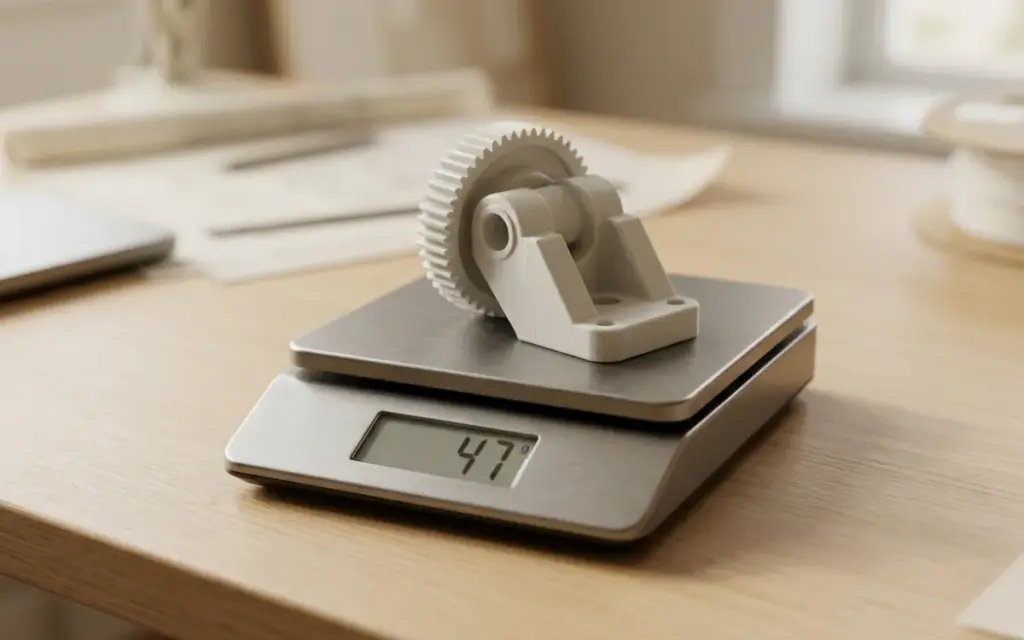
The main factor in the price is the weight of the finished part. Any free slicer — a program that prepares a model for printing — will show it:
- Download Ultimaker Cura or PrusaSlicer.
- Open the model in STL or OBJ format.
- Choose the material, a layer height of 0.2 mm and 20% infill.
- Click “Slice” — the program will show the weight in grams and the print time.
Then it’s multiplication: the slicer showed 50 g of PLA, so 50 × 5 UAH = 250 UAH. This is a basic estimate. Complex geometry, post-processing or modelling can change the amount, so I give the exact price after looking at the model.
6 factors that affect the final price
1. Material
This one’s clear — PLA or PETG. If you need a decorative part that will sit on a shelf, choose PLA and pay less. Need an enclosure for a device that heats up? Then PETG — no question. More about our materials on a separate page.
2. Infill percentage
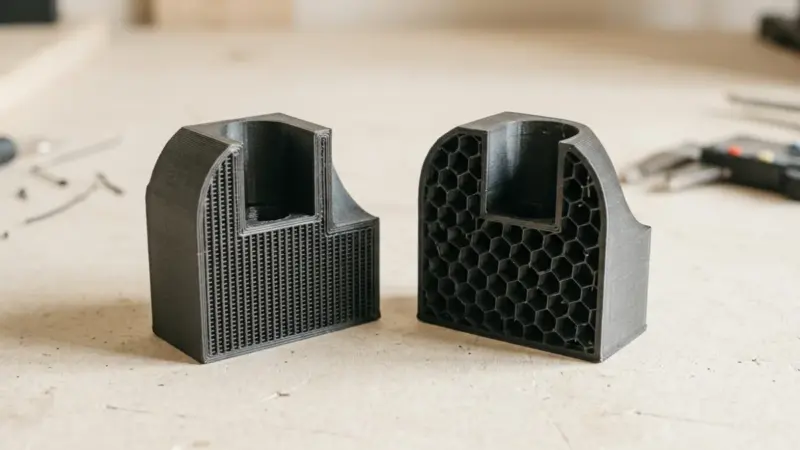
This is how much of the inside of the part is filled with plastic. 100% is a solid lump of plastic. 20% is a honeycomb structure with air inside.
An example with a real part. A 5×5×5 cm cube:
- At 20% infill — about 45 g = 225 UAH (PLA)
- At 50% infill — about 85 g = 425 UAH (PLA)
- At 100% infill — about 155 g = 775 UAH (PLA)
See the difference? A solid part needs three to four times more plastic — and costs accordingly. For most jobs, 20–30% infill is quite enough. I always suggest the best option.
3. Supports
If a part has overhanging features, the printer prints extra supports so the plastic doesn’t sag in mid-air. These supports are then broken off and thrown away. But plastic is used for them, and that has to be paid for too.
A simple example: the letter “T”. The horizontal bar needs supports underneath. This can add 15–40% to the weight of the part.
4. Geometric complexity
Thin walls, small details, precise dimensions with a 0.1 mm tolerance — all of these require slower printing and more careful set-up.
5. Order volume
One 15-gram part is one thing. A batch of 50 identical parts is another. In batch printing I can place several parts on the bed at once. That’s why large orders often work out cheaper per unit.
When a batch reaches hundreds or thousands of pieces, moulding becomes more cost-effective — where the line lies is covered in the article 3D printing vs CNC vs moulding. Ideas for making money from small runs are in the article 3D printing for small businesses.
6. Post-processing
Removing supports, sanding, painting or gluing together several parts is manual work that adds to the price.
Real order examples
Here are a few typical orders from my practice (prices in PLA):
- GoPro helmet mount — 12 g, ~60 UAH
- Arduino Nano enclosure — 28 g, ~140 UAH
- Car phone holder — 45 g, ~225 UAH
- Enclosure for a home-made device (2 parts) — 110 g, ~550 UAH
- A batch of 20 identical caps — 8 g each, 160 g in total — from 700 UAH (volume discount)
How to save on 3D printing
- Choose PLA if the part won’t heat up and doesn’t need extra strength
- Reduce the infill — 15–20% is enough for decorative items
- Optimise the model — avoid unnecessary overhangs to reduce the amount of support
- Order in batches — 10 parts are cheaper per piece than one
- Rotate the model — the right orientation reduces overhangs and supports; I check 3–4 options before printing
- Make decor hollow — 2–3 mm walls with minimal infill
- Send the STL file — I’ll calculate the exact weight and price in 15 minutes
When it’s better to send the model straight away
Estimating it yourself works well for simple parts. It’s better not to calculate without advice if:
- the model has many overhangs and complex geometry;
- post-processing is needed — sanding, painting, gluing;
- the part has to fit others with tight tolerances — for FDM allow ±0.2 mm;
- you need a plastic with specific mechanical properties;
- there’s no model and it has to be created from scratch.
Important: I print only from a ready-made 3D model (STL, OBJ, STEP or 3MF). No model? I’ll tell you where to find a ready-made one (on Printables, Thingiverse or MakerWorld) or who can make it.
How to find out the exact price?
The simplest way is to send me a 3D model (STL, OBJ or STEP format). I load it into the slicer, set the required parameters and give you the exact weight and cost within 15 minutes.
Send the file any way you like: call +380 97 876 00 36 or use the form on the website. The quote is free.
Want an exact price for your part? Send an STL, OBJ or STEP — we’ll weigh the model in the slicer and give you the cost within an hour.
FAQ
How much does 3D printing cost per gram?
PLA from 5 UAH/g, PETG from 6 UAH/g. The final price depends on the weight of the part including supports, the complexity of the geometry and the quantity.
How do I calculate the price of 3D printing myself?
Open the model in a free slicer (Cura or PrusaSlicer), set a 0.2 mm layer and 20% infill and click “Slice” — the program will show the weight. Multiply it by the price per gram: 50 g of PLA × 5 UAH = 250 UAH. This is a basic estimate; we’ll give the exact price after looking at the model.
Why is PETG more expensive than PLA?
The plastic itself costs more, and printing is harder: a higher temperature, lower speed and more calibration. In return the parts are stronger and more heat-resistant.
How can I reduce the cost of printing?
Choose PLA for parts without heat or load, use 15–20% infill for decor, orient the model to minimise overhangs and order in batches.
How can I find out the exact price of my part?
Send a 3D model in STL, OBJ or STEP format — we’ll load it into the slicer and tell you the exact weight and cost. The quote is free.