What FDM 3D printing is and how it works
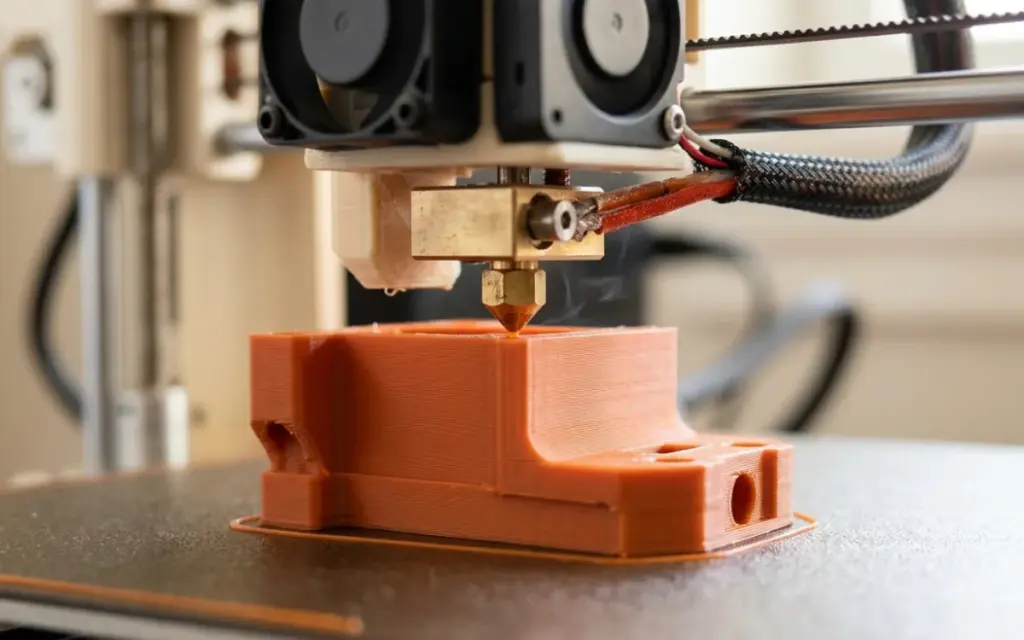
FDM 3D printing in plain words
FDM (Fused Deposition Modeling) is a technology that prints objects layer by layer from melted plastic. If you’ve ever seen a 3D printer at work, there’s a 95% chance it was FDM. This technology made 3D printing affordable: startups, large companies and hobbyists all use it.
At 3dprint.lviv.ua we work exclusively with FDM. In our experience, it covers 90% of what customers need: from prototypes and enclosures to decorative items and spare parts.
How it works
The principle is simple: a plastic strand (filament) 1.75 mm in diameter is fed into a heated head (the hotend). There it melts at 190–260°C and is laid down on the build platform through a fine nozzle (0.2–0.8 mm).
Printing goes from the bottom up:
- First layer — goes down on the heated platform. The whole print depends on the quality of the first layer. We always level the bed before important orders.
- Next layers — each new layer fuses with the one below, forming a strong structure.
- Finishing — the part cools down and is removed from the platform.
Layer height ranges from 0.1 to 0.3 mm. We most often print at 0.2 mm: it’s a good balance between quality and speed. We only use 0.1 mm layers when a perfect surface is needed — but the print time doubles.
What an FDM printer is made of
- Extruder — pushes the filament into the hotend.
- Hotend with nozzle — melts the plastic and extrudes it through the nozzle.
- Build platform (bed) — the surface the part grows on. Usually heated.
- Motion system — stepper motors and guide rails that move the head precisely along the X, Y and Z axes.
- Controller — the electronic board that runs the process from G-code.
Popular FDM printers
There are hundreds of options on the market — from budget desktop machines to industrial ones. These are the most common:
- Prusa — Czech printers of the i3 MK series, known for reliability. We print on Prusa ourselves for orders where repeatability matters.
- Creality — the Ender and CR series, the standard for beginners. Cheap, but they need tuning.
- Bambu Lab — the new generation: fast, with auto-calibration and minimal setup.
- Voron — an open-source project for those who want to build a printer themselves and get maximum performance.
For commercial print-on-demand work, proven printers with an enclosed chamber are usually used — this guarantees consistent quality from part to part.
Advantages of FDM printing
- Affordable price — both printers and materials are much cheaper than for SLA or SLS.
- Wide choice of materials — from simple PLA to engineering plastics: PETG, ABS, TPU, nylon, polycarbonate, carbon fibre composites.
- Parts for real use — printed items are strong enough to do actual work, not just for show.
- From small to large — you can print parts from a few centimetres to 30–50 cm and more.
- Easy post-processing — parts can be sanded, painted and glued without trouble.
Limitations of FDM printing
Like any technology, FDM has its limits:
- Visible layers — the surface has a noticeable layered texture, especially with tall layers. A perfectly smooth surface needs post-processing.
- Limited detail on tiny features — FDM loses to SLA/DLP when reproducing features smaller than 0.5 mm.
- Different strength in different directions — the bond between layers is weaker than within a layer. This matters when designing parts that carry loads.
- Supports are needed — overhanging features are printed with helper structures that are removed afterwards.
For most practical tasks these limitations aren’t critical. FDM remains the best choice for value for money.
Where FDM 3D printing is used
- Prototyping — checking shape, dimensions and function before mass production. We print prototypes for startups and engineering teams every week.
- Enclosures and covers — for electronics, IoT devices and DIY projects.
- Spare parts — broken parts of household appliances, cars and furniture. One of our most popular types of order.
- Tools and fixtures — jigs, holders and organisers for production.
- Architectural models — scale models of buildings.
- Education and hobbies — teaching models, figurines, cosplay.
- Small-batch production — small runs without the cost of moulds.
Why FDM suits print-on-demand
When customers come to us, FDM is the best option in 9 cases out of 10. Three reasons:
Price. FDM printing costs 3–5 times less than SLA or SLS. For prototypes and small batches this is critical. Speed. We complete most orders in 1–3 days. Choice of materials. We can pick a plastic for the specific task: tough PETG for functional parts, flexible TPU for shock absorbers, PLA for decor.
At 3dprint.lviv.ua you can order FDM 3D printing in different materials. We’ll help you choose the material and settings for your project. More about materials is on the materials page, and prices are in the price list.
In short
FDM is a proven, affordable technology for a wide range of tasks: from prototypes to production parts. A big choice of materials, an attractive price and enough strength for real use. If you need a plastic part, FDM will very likely do the job.
Got a project for 3D printing? Message us — we’ll work out the price, choose the material and print it.
Order 3D printing
Need quality 3D printing? printing materials. 3D printing prices. order 3D printing. Delivery across Ukraine by Nova Poshta.
Want to test an idea for real? Send the model — we’ll print it in PLA or PETG and quote it within an hour.