3D printing for board games: miniatures, tokens and accessories
Why do tabletop gamers need 3D printing?
Board games are enjoying a real renaissance — from classic Euro games to complex Dungeons & Dragons campaigns and huge Warhammer battles. But the deeper you get into the hobby, the more you want personalisation: unique miniatures, handy organisers and custom tokens you won’t find in any shop. This is where 3D printing for board games becomes an indispensable tool.
The technology lets you create practically any gaming accessory — from a tiny 28 mm character figure to a massive dice tower. And it’s all available today: all you need is a 3D model and a 3D printing service.
What can be printed for board games?
The possibilities of 3D printing in board games are impressively varied. Here are the most popular categories of items gamers order.
Miniatures for D&D, Warhammer and other systems
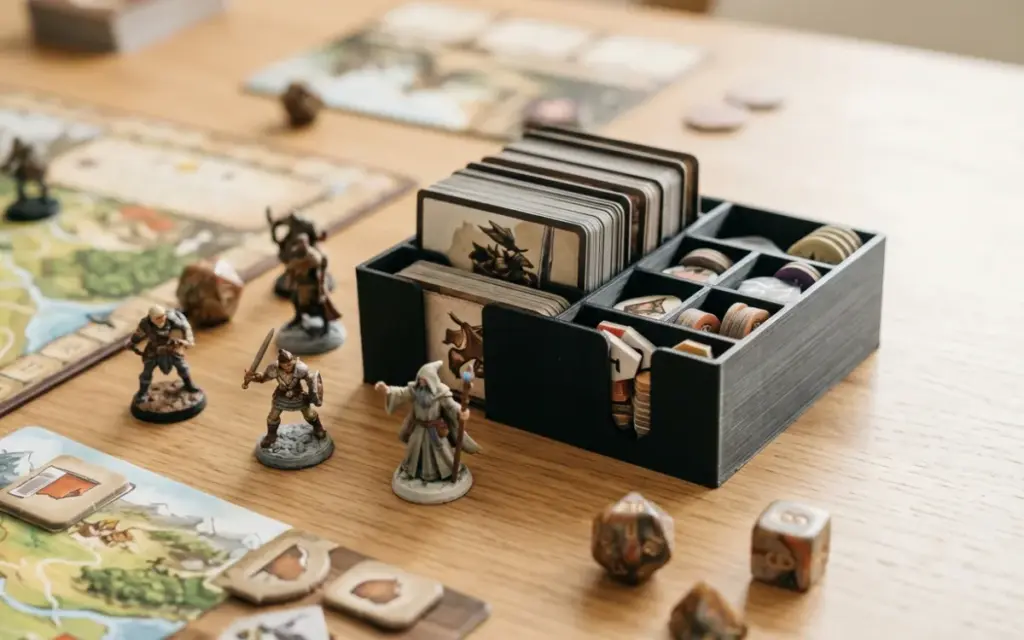
Miniatures are the heart of many tabletop games. In Dungeons & Dragons every player wants a figure that matches their character exactly: an elven archer, a dwarven paladin, a tiefling wizard. Buying one in a shop is practically impossible, but printing it on a 3D printer is entirely realistic.
For Warhammer 40K and Age of Sigmar, 3D printing opens up custom scenery, objective markers and extra terrain that will make your battlefield truly epic. And the detail on modern printers can reproduce even the smallest elements — facial expressions, armour texture, ornaments on weapons.
Custom counters and tokens
Standard cardboard tokens from the box wear out quickly and look shabby. Printed 3D counters and tokens are a different story. Coins for economic games, health markers, resource tokens, status indicators — all of these can be made sturdy, pleasant to touch and visually appealing. Instead of a flat cardboard “gold” token, you get a textured coin that feels good in your hand.
Box organisers for games
Anyone who has played Gloomhaven, Ark Nova or Twilight Imperium knows the problem: hundreds of components, dozens of little bags, and every game starts with a long sort-out. A 3D-printed organiser solves this once and for all. Every component has its place, game setup drops from 20 minutes to five, and the box finally closes flat.
Organisers are designed for a specific game, including all its expansions. There are separate card trays, recesses for miniatures, sections for tokens — all fitted perfectly to the size of the box.
Dice towers
A dice tower isn’t just a functional accessory but a real ornament for the gaming table. 3D printing lets you create a dice tower in any design: a medieval tower, a dragon’s lair, a space station or even a portal in the style of your favourite game. The dice drop in, pass through a system of baffles and roll out at the bottom — fair, random and spectacular.
Card holders and other accessories
Handy card holders are a must for games where you hold many cards at once. Children and people who find it hard to hold a fan of ten cards especially appreciate them. Besides card holders, player board stands, reference card holders, discard trays and special dashboard stands are popular.
Terrain and scenery for the game board
In wargames and role-playing games, the scenery on the table is half the atmosphere. 3D-printed terrain includes buildings, ruins, trees, rocks, bridges, walls and entire dungeons. A modular system lets you combine pieces and create a new board for each session. Compared with buying ready-made terrain from well-known brands, printing costs several times less, and the choice of designs is practically unlimited.
Which material suits gaming miniatures and accessories?
For most gaming items, PLA plastic is the best choice. Here’s why:
- Detail: PLA reproduces fine details beautifully, which is critical for 28–32 mm miniatures.
- Easy to paint: a PLA surface takes acrylic paints, primers and varnishes well. After painting, a miniature looks as good as a factory one.
- A wide range of colours: even without painting, you can print counters and tokens in the right colour — red for one player, blue for another.
- Strength: PLA is hard enough for game components that are handled regularly.
- An affordable price: of all 3D printing materials, PLA remains one of the most budget-friendly.
For large organisers under constant load, PETG also works well — it’s slightly more flexible and impact-resistant.
Where to find 3D models for board games
One of the best things about this hobby is the huge community sharing free and premium models. Here are the three main resources:
- MyMiniFactory — the largest library of tabletop miniatures. Thousands of models from professional sculptors: characters, monsters, terrain. There are both free and paid models of the highest quality.
- Thingiverse — a huge free database where you can find organisers for practically any popular game, dice towers, card holders and tokens.
- Printables — a fast-growing platform with an active community. Many quality free models of board game accessories with detailed instructions and recommended print settings.
Found the model you need? Just download the STL file and send it to us for printing. And if you need a unique miniature from your own description, you can create a 3D model from scratch or adapt an existing one.
Tips for the best result
- Print miniatures at high detail — choose the minimum layer height to capture all the fine elements.
- Always prime before painting: a coat of primer hides the print lines and ensures paint goes on evenly.
- For organisers, measure the inside of the box: even tested models from the internet may not fit because of different editions of a game.
- Print a test piece: before ordering a full set of tokens or counters, it’s worth printing one and checking the size and feel.
How much does it cost?
The price depends on the size, detail and number of items. A single 28 mm miniature costs a few dozen hryvnias, an organiser for a big game from a few hundred. Compared with buying branded accessories or miniatures from well-known makers, 3D printing is usually 2–5 times cheaper, and the result is just as good.
The more units in an order, the better the per-piece price. That’s why players often team up with friends or their gaming group to order a set for everyone at once.
Ready to level up your board games?
Send us a link to the model or describe what you need — we’ll work out the price, choose the best material and print your miniatures, organisers or accessories. Free advice and quote.
Have an idea for something to print? Send a model or a photo of the part — we’ll quote it within an hour and suggest the right material.